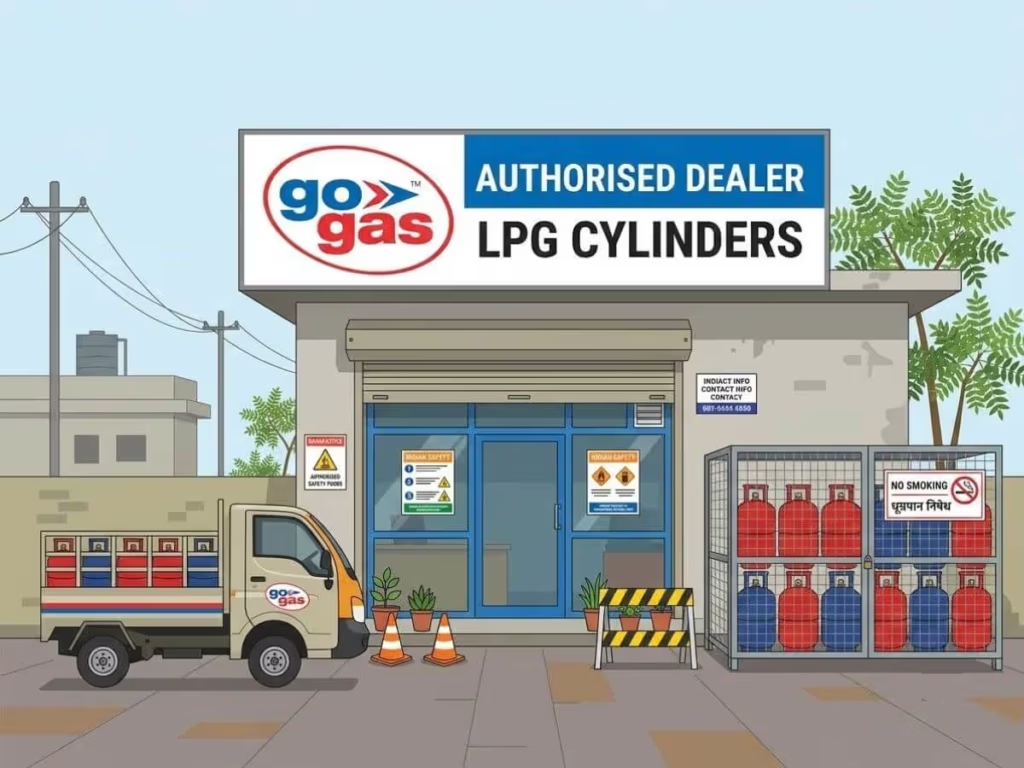
LPG is the one commodity that gets refilled in almost every Indian kitchen, month after month, year after year. Demand does not dip in a recession.
Nobody skips buying a cylinder because prices went up a little. That steady, uninterrupted demand is exactly what makes an Indane gas agency one of the more stable small business opportunities in India.
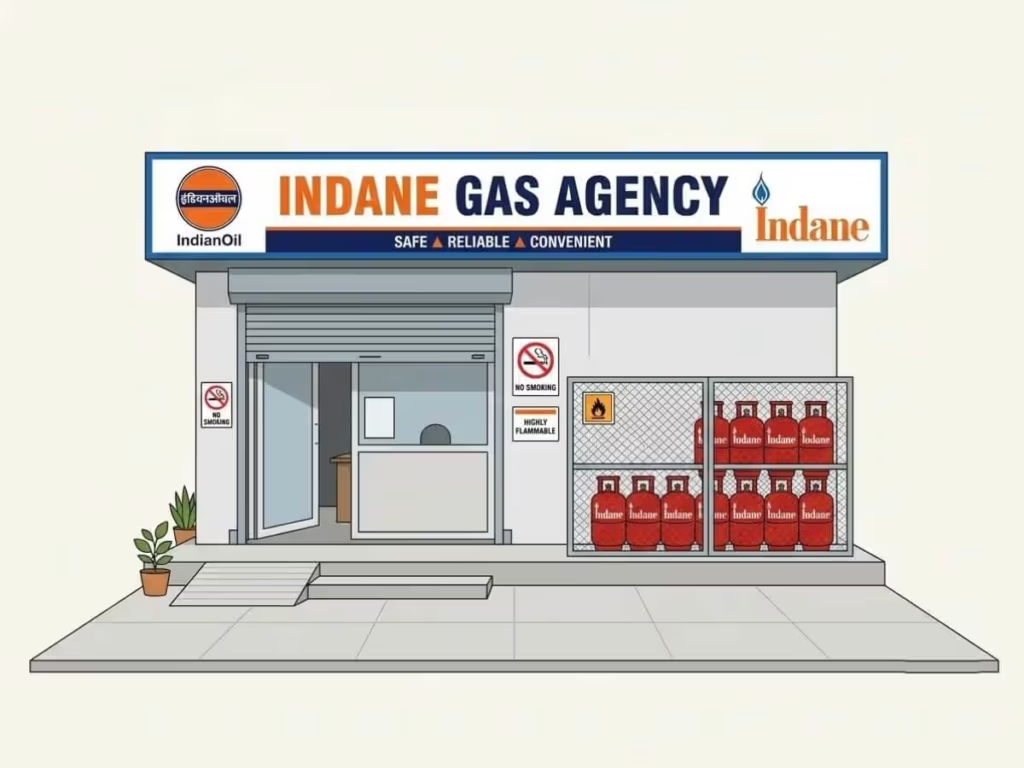
Before you understand the income potential, there is something most people do not realise upfront. You cannot simply open an Indane agency by paying a fee. Selection happens through a computerised lottery.
No interviews, no merit ranking — just a draw of lots. Applications open in specific windows. If you miss the window or lose the draw, you wait for the next round.
This article gives you information on the real cost of setting up an Indane gas agency, the actual commission you earn per cylinder, how much profit a mid-sized agency makes, and what the whole process looks like from application to opening day.
In this post,
What Is an Indane Gas Agency?
Indane is the LPG brand of Indian Oil Corporation Limited (IOCL), a Government of India Maharatna PSU. It is the single largest LPG network in the country, with over 12,000 distributors serving roughly one in every two LPG connections in India. India has over 35 crore+ active domestic LPG connections — a market that keeps growing.
When you become an Indane distributor (officially called a Vitrak), you are the supply link between the nearest IOCL bottling plant and the households in your assigned territory. Customers book refills through the IOCL app or helpline; you collect cylinders from the plant, store them in your godown, and deliver them to homes.
Your earnings come from a per-cylinder commission, not from any markup on the gas price. The price customers pay is fixed by the government. Your income depends on how many cylinders you deliver.
Indane Gas Agency Dealership Cost
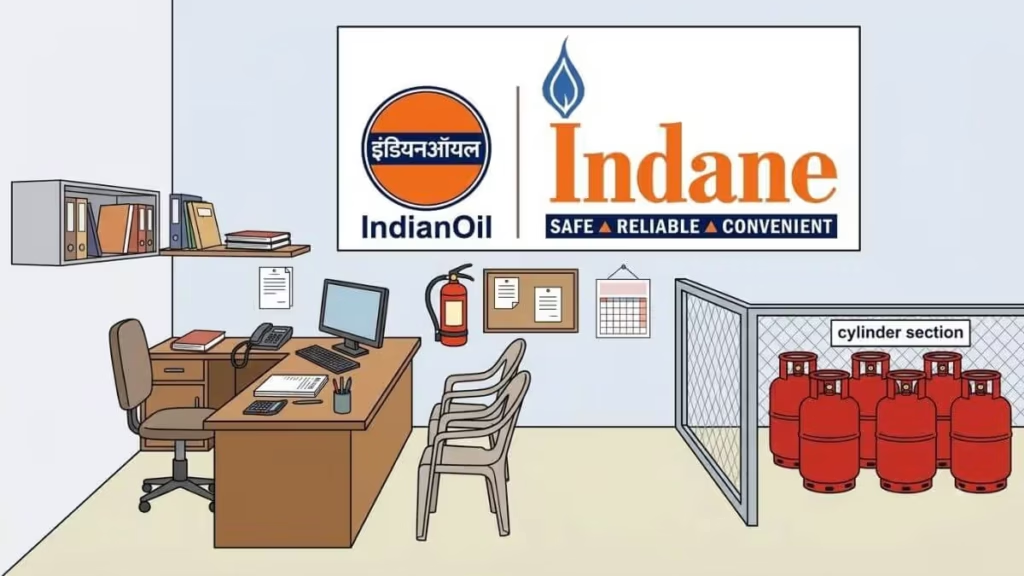
The total investment to set up an Indane gas agency falls between ₹15 lakh and ₹30 lakh, depending on whether you already own land for the godown or need to build from scratch.
Here is a rough breakdown:
| Cost Component | Low Estimate | High Estimate |
|---|---|---|
| Security deposit to IOCL (refundable) | ₹1 lakh | ₹5 lakh |
| Godown construction (PESO-compliant) | ₹5 lakh | ₹12 lakh |
| Showroom setup | ₹1 lakh | ₹2 lakh |
| Delivery vehicles (2–3 tempos) | ₹4 lakh | ₹8 lakh |
| Cylinder deposit inventory | ₹3 lakh | ₹5 lakh |
| Working capital (3 months) | ₹2 lakh | ₹4 lakh |
| Application fee (refundable if not selected) | ₹15,000 | ₹25,500 |
| Total | ~₹16 lakh | ~₹36 lakh |
These figures assume you have land available. If you need to acquire or lease a plot for the godown, add ₹8 lakh to ₹15 lakh depending on your location. In a Tier-2 city or semi-urban area, the total realistic outlay can reach ₹25–45 lakh once land is included.
The Godown Requirement
This is the most commonly underestimated part of the setup. Your godown must meet PESO (Petroleum and Explosives Safety Organisation) standards. That means specific minimum distances from residential buildings, proper ventilation, cylinder stacking norms, fire safety equipment, emergency access routes, and a fire NOC from local authorities.
You cannot rent a regular warehouse and call it done. The PESO licence is a hard requirement, and IOCL will verify the site before issuing a Letter of Intent. A showroom of at least 2.6m by 3.0m is also required within 500 metres of the godown.
Profit Margin in Indane Gas Agency Dealership
Your income comes from the per-cylinder commission that IOCL pays you for each delivery. For a standard 14.2 kg domestic cylinder, the total commission is around ₹73 per cylinder — broken into an installation component of roughly ₹40 and a delivery component of roughly ₹33. For the smaller 5 kg cylinder, the commission is approximately ₹37.
Beyond domestic cylinders, additional income comes from new connection fees, sale of gas stoves and regulators, and delivery of commercial cylinders, which carry a higher commission per unit.
Here is what a typical agency earns monthly based on customer base size:
| Type of Agency | Monthly Deliveries | Monthly Gross Income | Monthly Expenses | Net Profit |
|---|---|---|---|---|
| Small rural agency | 1,500–2,500 cylinders | ₹1.1–1.8 lakh | ₹40,000–65,000 | ₹70,000–1.15 lakh |
| Mid-sized semi-urban | 3,000–5,000 cylinders | ₹2.2–3.6 lakh | ₹80,000–1.2 lakh | ₹1.4–2.4 lakh |
| Larger urban agency | 6,000–10,000 cylinders | ₹4.4–7.3 lakh | ₹1.5–2.5 lakh | ₹2.9–4.8 lakh |
The customer base you are assigned depends entirely on the territory and location you apply for. You do not choose the size of the area; IOCL assigns it. An urban dealership sounds more profitable, but competition for those seats in the lottery is also much higher.
The Break-Even Period?
At a net monthly profit of ₹1–1.5 lakh for a mid-sized agency, and a total setup investment of around ₹25 lakh (including godown and vehicles), you are looking at a break-even of roughly 18 to 30 months. The security deposit to IOCL is refundable at the end of the dealership, which improves the long-term picture.
Hidden Costs and Risks
A few costs that often catch new dealers off guard:
Staff salaries are a real monthly outgoing. You will need at minimum 2–3 delivery personnel and a godown helper. In a semi-urban area, this adds ₹30,000–50,000 per month to your fixed costs.
Vehicle running costs, including fuel, maintenance, and insurance on 2–3 tempos, can add another ₹20,000–35,000 monthly.
Commission rates are revised by the OMC periodically. The amounts mentioned here reflect rates current at the time of writing, but these can change.
Longer term, urban areas with expanding piped natural gas (PNG) networks will see LPG demand slowly reduce over time. Rural and semi-urban locations are better insulated from this for at least the next decade.
How to Apply for an Indane Gas Agency Dealership
Applications are handled through the unified portal at lpggasdealerchayan.in, which covers Indane (IOCL), HP Gas (HPCL), and Bharat Gas (BPCL). The three companies open windows periodically and announce them through the portal and local newspapers.
The basic eligibility criteria are straightforward. You must be an Indian citizen aged between 21 and 60, have passed at least the 10th standard, and be able to demonstrate financial capacity for the investment.
The process runs roughly like this. Register on the portal, select your preferred location and distributorship category (rural, rurban or regular), upload documents (Aadhaar, PAN, land papers, financial statements, educational certificates), pay the refundable application fee of ₹15,000 to ₹25,500, and submit before the deadline.
After the window closes, a computerised draw of lots is held. If you are selected, IOCL conducts a Field Verification Check at your proposed godown site. A Letter of Intent follows. You then build the PESO-compliant godown, obtain clearances, and sign the distributorship agreement. The initial dealership term is 10 years.
If you are not selected, your application fee is refunded within a couple of weeks, and you can apply in the next window without any limit on attempts.
One important restriction:
You or any immediate family member cannot hold dealerships with more than one PSU oil company. If anyone in the family already has a gas agency or petrol pump with any PSU, you are disqualified from applying.
Indane vs HP Gas vs Bharat Gas Dealership?
All three PSUs run the same model — same investment range, same commission structure, same draw-of-lots selection. The differentiator is network density near your location. Apply for the company with fewer existing distributors in the area you want, as that gives you a larger territory.
Indane has the biggest national network, which also means more competition in popular locations. HP Gas and Bharat Gas have smaller networks overall, which can mean better territory sizes in areas where they are less represented.
How to Start with Smaller Investment?
If the ₹20–30 lakh investment feels too steep right now, a Gramin Vitrak (rural distributorship) has lower land requirements and a smaller territory, which also means lower setup cost — sometimes in the ₹12–18 lakh range including vehicles. The income is lower, but so is the initial risk. Several people start with a rural agency, build operational experience and cash flow, and then apply for a larger regular distributorship in the next window.
An Indane gas agency is not a business you start in a hurry. It needs land, upfront capital, PESO compliance, and the patience to wait out the lottery. But once running, it delivers one of the more stable income streams in the small business world, backed by government infrastructure and a customer base that grows every year.

Suraj Shetty
Suraj Shetty has over 8 years of experience in small business, startups, and business consulting. He shares practical insights and proven strategies to help entrepreneurs discover new opportunities and grow their businesses sustainably.
Kaushik Nitin
30 years of experience in business consulting across diverse industries