Starting an HP Gas agency (LPG distributorship under HPCL) costs between ₹15 lakh and ₹30 lakh in total, covering godown construction, delivery vehicles, equipment, and working capital. The refundable security deposit paid to HPCL is ₹40,000 to ₹50,000 depending on your category. You earn roughly ₹73 per 14.2 kg domestic cylinder sold. A mid-sized agency serving 2,000 to 3,000 connections can generate a net monthly income of ₹60,000 to ₹1,50,000. Break-even on the infrastructure investment typically takes two to four years.
In this post,
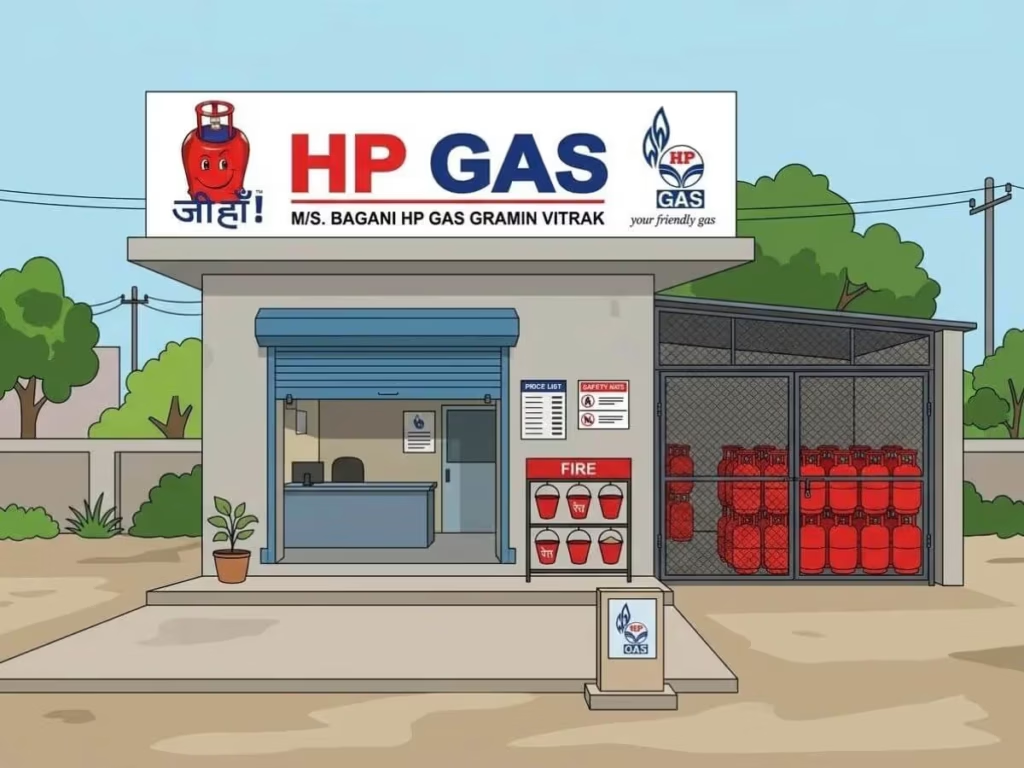
An HP Gas agency can be a very stable and long-term business. But getting one is not as simple as filling a form and waiting. The process is transparent, government-controlled, and competitive. If you are serious about it, you need to understand the investment it requires, the eligibility conditions, and the profit you can expect.
What Is an HP Gas Agency?
HP Gas is the LPG brand of Hindustan Petroleum Corporation Limited (HPCL), one of India’s three public sector oil marketing companies (OMCs). There are over 35 crore+ active domestic LPG connections across the country, and HP Gas holds a significant share of that network.
An HP Gas agency, formerly called a distributorship, is the last-mile link between HPCL and its customers. You receive filled cylinders from HPCL’s bottling plant, store them at your godown, and deliver them to households and commercial customers in your designated area. You earn a fixed commission on every cylinder delivered.
HPCL does not sell franchises or dealerships the way a fast food brand does. All three public sector OMCs — HPCL, IOCL and BPCL — follow a unified government-approved selection process. Applications are filed on a single official portal, and selection happens through a draw of lots.
Who Can Apply for an HP Gas Dealership?
To apply for the HP Gas dealership, you must be an Indian citizen between the ages of 21 and 60. A minimum education of Class 10 (matriculate) is required. Crucially, only one person per family can hold any kind of LPG distributorship or dealership from any OMC. If your spouse or parent already holds one, you are not eligible.
You also need to have land or a lease arrangement suitable for a godown that meets PESO (Petroleum and Explosives Safety Organisation) safety standards. The godown must be accessible by heavy trucks for cylinder delivery. This land requirement is often the biggest practical hurdle, especially in urban areas.
There are four categories of distributorship under the HP Gas network:
Sheheri Vitrak covers urban areas.
Rurban Vitrak covers semi-urban or peri-urban zones.
Gramin Vitrak serves rural villages.
Durgam Kshetriya Vitrak (DKV) is for remote and difficult terrain areas.
Your category determines the application fee, security deposit, and minimum godown size you need.
HP Gas Agency Dealership Cost
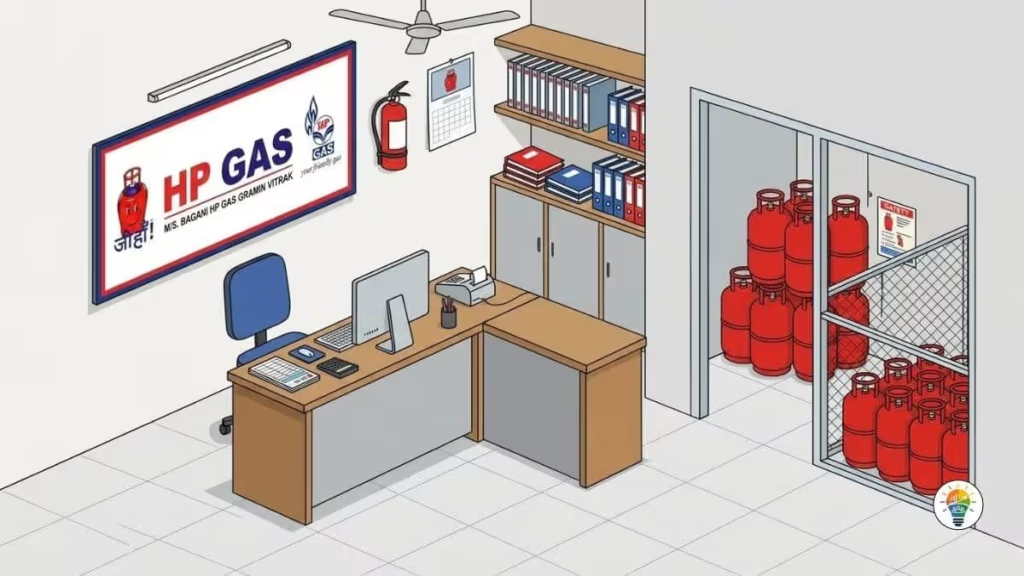
The security deposit is the smallest part of your actual investment. The big money goes into building the godown, setting up a small showroom, buying delivery vehicles, and creating working capital. Here is the breakdown,
| Cost Head | Approximate Range |
|---|---|
| Security deposit (refundable) | ₹40,000 – ₹50,000 |
| Godown construction (PESO compliant) | ₹4,00,000 – ₹8,00,000 |
| Showroom setup | ₹50,000 – ₹1,50,000 |
| Delivery vehicle (LCV or tempo) | ₹4,00,000 – ₹8,00,000 |
| Equipment (weighing scale, racks, safety gear) | ₹50,000 – ₹1,00,000 |
| Licences and NOCs | ₹20,000 – ₹50,000 |
| Initial working capital | ₹2,00,000 – ₹5,00,000 |
| Total estimated investment | ₹15 lakh – ₹30 lakh |
If you own the land where the godown will be built, your costs will sit closer to the lower end. If you need to lease land or if you are in a metro or a Tier 1 city, costs push toward ₹25–30 lakh.
Costs also vary by state. Godown construction in a small Maharashtra town costs less than in an NCR suburb. A rural agency in Rajasthan can be set up for under ₹18 lakh, while a Sheheri agency near a large city could touch ₹28–30 lakh.
Profit Margin in HP Gas Agency Dealership
Your earnings come primarily from the commission HPCL pays per cylinder delivered. On a 14.2 kg domestic cylinder, the total commission is ₹73.08. This is split into an installation component of ₹39.65 and a delivery component of ₹33.43. On a 5 kg cylinder, the commission is ₹36.54.
Commercial cylinders (19 kg and 47.5 kg) carry separate margins and can be a useful addition to your revenue, particularly if you are near a market area with restaurants, dhabas or small factories.
You can also earn from issuing new gas connections, selling gas stoves and related accessories, and providing annual maintenance services.
To see what this means in practice, consider a mid-sized urban agency with 2,500 active domestic connections. If each customer books roughly one cylinder per month, that is 2,500 cylinders.
At ₹73.08 per cylinder, gross commission is around ₹1,82,700 per month.
From this, your running costs need to come out. A rough monthly cost picture looks like this:
- Staff (2 to 4 people) — ₹25,000 to ₹50,000
- Vehicle fuel and maintenance — ₹10,000 to ₹20,000
- Electricity and office expenses — ₹3,000 to ₈,000
- Miscellaneous — ₹5,000 to ₹10,000
Monthly running costs for a typical agency sit between ₹45,000 and ₹90,000. After these, a 2,500-connection agency can net anywhere from ₹90,000 to ₹1,30,000 a month. A smaller rural agency with 800 to 1,000 connections may net ₹25,000 to ₹45,000.
This is a steady, recurring income — not a volatile one. But it is not dramatically high either. The profit margin as a percentage is thin, roughly 40 to 55 per cent of gross commission, which is why volume matters enormously. The more subscribers you serve, the better your income.
The Hidden Costs and Risks
The per-cylinder commission of around ₹73 has not been revised significantly in several years, while costs like diesel, staff salaries, and vehicle maintenance keep rising. This margin squeeze is the single biggest concern for gas agency owners, and it is something you should plan around carefully before investing.
Other costs people overlook include:
Vehicle breakdown or accident costs.
Delivery vehicles take a beating over time. Budget for annual maintenance and keep a buffer for emergency repairs.
Dry-out risk.
If HPCL’s bottling plant faces supply issues, you may not have cylinders to deliver, but your fixed costs continue. Keeping a reasonable stock buffer helps.
Fraud losses.
Cylinder theft or manipulation by delivery staff does happen. Proper supervision and weighing checks at dispatch reduce this risk.
PESO compliance costs.
Godowns need to be maintained to safety standards. Any violations can lead to temporary suspension of your licence, which stops all income.
Also Read:
Indane Gas Agency Cost – Complete Guide
Go Gas Agency Cost – Complete Guide
Can You Get a Loan to Start an HP Gas Agency?
Yes. MUDRA loans under the Pradhan Mantri MUDRA Yojana can help smaller applicants cover vehicle and working capital costs. Kishore and Tarun category MUDRA loans (₹5 lakh to ₹10 lakh and ₹10 lakh to ₹50 lakh, respectively) are relevant here. Banks also extend loans specifically for vehicle purchase under the commercial vehicle loan category.
Some HPCL regional offices also facilitate tie-ups with banks for selected distributors, particularly in rural areas where encouraging new dealerships is a policy priority.
How to Apply for an HP Gas Agency
Applications are accepted only when HPCL (or any OMC) advertises a specific vacancy for your area. You cannot apply speculatively. Watch the official portal lpgvitarakchayan.in and local newspapers for such advertisements.
Once an advertisement is published for your area, you register on lpgvitarakchayan.in and submit your application online along with the non-refundable application fee. For urban (Sheheri) applicants in the Open category, this fee is around ₹10,000. For Gramin and DKV categories, it comes down to ₹8,000.
After the application window closes, all eligible applicants go through a computerised draw of lots. HPCL then does a field verification of the selected candidate — they check your godown land, finances, and documents. If everything is in order, you pay the security deposit and receive your Letter of Appointment.
The security deposit is refundable when you exit the business. For Sheheri and Rurban categories, it is ₹50,000. For Gramin and DKV, it is ₹40,000. A common myth spread online puts this deposit at ₹5 lakh — that figure belongs to petrol pump dealerships, not gas agencies.
One important warning: scammers run fake websites that look like the official portal and demand money for “guaranteeing” selection. HPCL only ever charges the published application fee through the official portal. No agent, middleman or caller can get you selected.
Questions
What is the minimum land required for an HP Gas agency godown?
The godown must meet PESO safety standards and be accessible to heavy trucks. For Sheheri and Rurban categories, the plot is typically around 21 by 26 metres, though exact norms vary by state. For Gramin and DKV categories, the requirement is somewhat smaller. Kerala has different land norms.
Can I run an HP Gas agency as a side business without being involved daily?
No. HPCL’s distributorship agreement requires the appointed individual to be actively involved in managing the agency. You cannot hand over day-to-day operations entirely to a manager or a partner who is not named in the agreement. Hiring delivery and office staff is normal, but personal oversight is mandatory.
What Licences and Registrations Do You Need?
The most important one is the PESO Form F licence for LPG cylinder storage. Every gas agency godown stores thousands of kilograms of LPG at any point, which squarely falls under the Gas Cylinders Rules. You need the PESO licence before you can begin operations.
Beyond PESO, you will need a Fire NOC from your local fire department, a No Objection Certificate from the local body (municipality or panchayat) for the godown, and compliance papers for your delivery vehicles under hazardous goods transportation rules. Udyam registration under MSME is also common and useful for accessing business loans.
An HP Gas agency requires an investment of ₹15 to ₹30 lakh, a fair amount of paperwork and a selection process you cannot control entirely. But once running, it provides stable recurring income tied to everyday household demand. Commission rates are modest and have been stagnant for a while, so your profitability depends heavily on building and retaining a large subscriber base. Go in with realistic expectations, ensure your land and godown are ready before you apply, and apply only through the official lpgvitarakchayan.in portal.
SmallBusinessHub.in is an independent informational website and is not affiliated with the brands or companies mentioned unless explicitly stated. Business, franchise, dealership, and investment information is provided for general informational purposes only and may change over time. Always verify details directly with the relevant company before making a business decision. We do not provide financial, legal, or investment advice. [Read our full Disclaimer].

Suraj Shetty
Suraj Shetty has over 8 years of experience in small business, startups, and business consulting. He shares practical insights and proven strategies to help entrepreneurs discover new opportunities and grow their businesses sustainably.

Ravi Shankar
28 years of experience in business consulting across diverse industries