A Goldmedal Electricals dealership in India requires a total investment of roughly ₹8 lakh to ₹25 lakh for a retail dealer setup, depending on city tier, shop size, and stock depth. This covers a refundable brand security deposit, shop fit-out, initial inventory, and working capital.
Dealer trade margins on Goldmedal products range from 10% to 20% depending on the product category, with modular switches and wiring devices offering the better end of that range. A well-run dealership can break even within 12 to 18 months of operation.
In this guide,
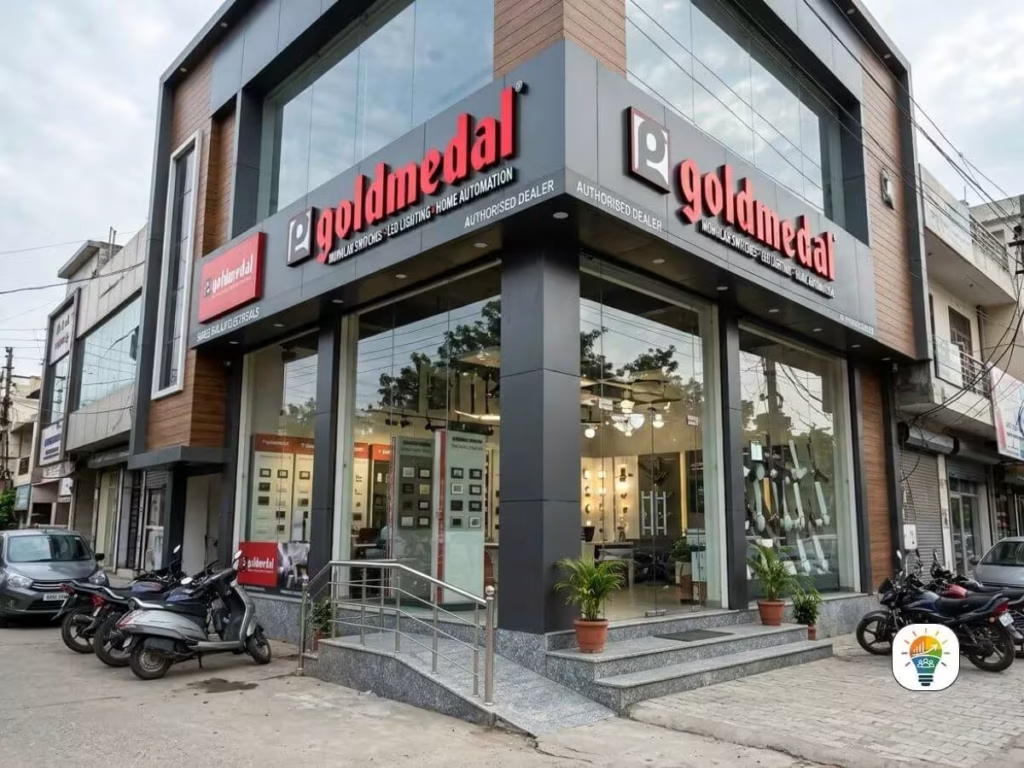
Every electrician in India knows the Gold Medal brand name. It has a good brand recognition, built over four decades, and a network of more than 20,000 direct and indirect dealers across the country. That is why many aspiring entrepreneurs look at Goldmedal Electricals as a dealership option.
But brand recognition alone does not make a business. Before you approach the company’s branch office or fill out an inquiry form, you need an idea of what this costs, what you can earn, and where the risks sit.
What is Goldmedal Electricals?
Goldmedal Electricals Private Limited is a Mumbai-headquartered Fast Moving Electrical Goods (FMEG) company founded in 1979. Started as a small electrical trading shop in Vijayawada with ₹2.5 lakh capital, it has grown into a business that crossed ₹2,600 crore in annual revenue. It carries a CRISIL A+ credit rating, which signals strong financial health.
The product portfolio is wide. Goldmedal manufactures modular switches and wiring devices, wires and cables, LED lights and luminaires, ceiling fans, MCBs, distribution boards, home automation systems, doorbells, and PVC pipes. Its manufacturing units are in Vasai (Maharashtra), Bhiwadi (Rajasthan), and Vijayawada (Andhra Pradesh). The company operates 22 branches and experience centres across major cities, so regional dealer support is accessible.
For a dealer, a wide product range means you are not dependent on one or two SKUs. When a housing project comes to your area, you can supply switches, wires, fans, and lighting — all from one brand.
Goldmedal Dealership Cost

Goldmedal operates an authorised dealer and distributor model where the investment is primarily in inventory, security deposit, and your own shop infrastructure. Here is a cost breakdown.
| Cost Head | Low Estimate | Average | High Estimate |
|---|---|---|---|
| Refundable Brand Security Deposit | ₹50,000 | ₹1,00,000 | ₹2,00,000 |
| Shop Deposit or Advance Rent | ₹30,000 | ₹80,000 | ₹2,00,000 |
| Shop Fit-out, Shelving & Display | ₹60,000 | ₹1,50,000 | ₹3,00,000 |
| Signage & Branding | ₹20,000 | ₹40,000 | ₹80,000 |
| Initial Inventory | ₹3,00,000 | ₹6,00,000 | ₹12,00,000 |
| Billing Software & Hardware | ₹15,000 | ₹30,000 | ₹60,000 |
| Working Capital (2–3 months) | ₹1,00,000 | ₹2,50,000 | ₹5,00,000 |
| Total | ~₹8 lakh | ~₹12–13 lakh | ~₹25 lakh |
A small dealer in a Tier 3 town with a modest 150–200 sq ft shop can get started closer to ₹8 lakh. Someone setting up a proper branded showroom in a Tier 1 or large Tier 2 city, with 400–600 sq ft of floor space and a wider product display, will land in the ₹18–25 lakh range.
The brand security deposit for Goldmedal is in the same range as other mid-premium electrical brands — roughly ₹50,000 to ₹2 lakh — and is refundable. It is not a franchise fee; it is a performance assurance deposit held by the company.
Monthly Running Costs
Once you are operational, your monthly outflows will include several fixed and variable heads.
Shop rent in a Tier 2 city will run between ₹15,000 and ₹40,000 depending on location and size. Metro rents are higher — ₹40,000 to ₹80,000 is realistic for a decent commercial spot. One sales staff member will cost ₹12,000 to ₹18,000 per month. Electricity, internet, and miscellaneous consumables add another ₹5,000 to ₹10,000.
The bigger monthly figure is stock replenishment — the inventory you need to keep buying to maintain adequate depth across categories. This varies with your monthly sales volume but is typically 70–80% of your monthly revenue at cost price. At a monthly turnover of ₹5 lakh, you are spending ₹3.5–4 lakh on restocking.
Do not forget GST compliance, accountant fees if you outsource bookkeeping, and the occasional logistics cost for receiving stock from the company’s depot or warehouse. These hidden running costs together can add ₹8,000 to ₹15,000 per month, and many new dealers overlook them entirely.
Profit Margin in Goldmedal Dealership
Trade margins in the FMEG and electrical goods segment are not uniform across product categories, and Goldmedal is no different.
Wires and cables are high-volume, lower-margin products. Trade margins here sit around 10–15% gross. Modular switches and wiring devices — Goldmedal’s signature category, with product lines like Curve, Nixon, and GIFA — offer better margins in the 15–20% range. LED lighting margins vary more widely, often 12–18% depending on the product tier. Home automation systems and premium smart switches carry the highest margins per unit, sometimes pushing 20–25% gross at the retail level, but their volumes are lower.
Your blended gross margin across the full portfolio will land between 12% and 18% for most dealers. After deducting monthly overheads, a typical net margin for a well-run electrical dealership is 7–12%.
To put this in real numbers: at a monthly revenue of ₹5 lakh and a 15% gross margin, you earn ₹75,000 gross. Subtract fixed costs of ₹35,000–40,000 (rent, staff, overhead), and your net profit is ₹35,000–40,000 per month. At ₹10 lakh in monthly revenue, the same logic gives you ₹70,000–90,000 in net monthly profit.
Dealers who build strong relationships with contractors, builders, and electricians in their area tend to do significantly better — project-based bulk orders can move large volumes at acceptable margins, and those relationships are hard for new entrants to displace once established.
How Long to Break Even?
For a Tier 2 city setup with a total investment of around ₹12–13 lakh, the break-even usually arrives in 12 to 18 months. A Tier 1 city setup with a ₹20–25 lakh investment can take 18 to 24 months if the ramp-up is slower.
The break-even timeline is closely tied to two things: how fast you build a network of electricians and contractors who recommend your shop, and whether the company assigns you a territory with genuine demand. Areas with active residential construction, renovation activity, or a dense electrician population are significantly better starting points than saturated markets.
Hidden Costs and Risks
One cost that surprises new dealers is the minimum offtake commitment. Goldmedal, like most branded electrical companies, expects you to maintain a minimum purchase volume per quarter or year to retain your authorised dealer status and qualify for scheme benefits. If your sales are slower than expected in the first few months, you may still need to place stock orders to meet these commitments.
Credit risk is another quiet drain. Many electricians and small contractors buy on credit and may take 30–60 days to pay. If you extend credit carelessly, your working capital gets locked, and you end up needing more cash to replenish inventory than your margins support.
Stock returns are limited. Electrical goods, especially wires purchased in bulk for specific projects, can sit in your store if the project stalls. Managing inventory depth without overstocking slow-moving SKUs is a skill that takes time to develop.
Finally, the electrical goods market has real competition from unorganised players who sell cheaper alternatives, particularly in price-sensitive Tier 3 markets. Goldmedal’s brand strength helps, but you will encounter contractors asking why they should pay a premium for a branded product when a cheaper switch does the same job.
Can You Start with a Smaller Investment?
If the full investment feels steep, there is a valid way to start lighter. Many successful Goldmedal dealers began as sub-dealers under a larger authorised distributor. As a sub-dealer, you buy stock from the main distributor in your area rather than directly from the company. Your margins are thinner — perhaps 8–12% instead of 15–18% — but your upfront investment and minimum commitment are far lower. You learn the category, build your electrician network, and graduate to a direct dealership once you have the volume to justify it.
Alternatively, you can start with a narrower product focus — wires, switches, and MCBs — rather than stocking the full portfolio from day one. This keeps your initial inventory investment in the ₹2–3 lakh range and lets you add categories as your cash flow permits.
A MUDRA loan under the Shishu or Kishor category can finance part of your working capital or inventory. The Pradhan Mantri MUDRA Yojana covers loans up to ₹10 lakh for small businesses, and an electrical dealership qualifies as a valid business for this purpose.
How Do You Become a Goldmedal Authorised Dealer?
The process is relationship-driven and territory-based. Goldmedal, like most brands, avoids saturating a single area with too many authorised dealers because that hurts everyone’s margins.
The standard route starts with reaching out to your nearest Goldmedal branch office. The company has branches in cities including Mumbai, Pune, Chennai, Bengaluru, Hyderabad, Kolkata, Ahmedabad, Jaipur, Siliguri, and others. You can also initiate a query through the company’s official website at goldmedalindia.com.
You will need a few basic things in place. GST registration is mandatory. A shop and establishment licence from your local municipal body is required for retail operations. A rental or ownership agreement for your shop space and a valid trade licence round out the basic documentation. The company’s sales team will assess your proposed territory, check whether the area is already covered, and evaluate your ability to meet a minimum annual offtake commitment.
Having a background in electrical trading, construction supply, or hardware retail is an advantage but not a strict requirement. What matters more is location, capital readiness, and local market knowledge.
The brand’s wide product portfolio, strong network support, and four-decade track record give a dealer something meaningful to sell. Start with clarity on your territory, your capital limits, and your ability to build ground-level relationships — those three things determine the outcome more than anything else.
SmallBusinessHub.in is an independent informational website and is not affiliated with the brands or companies mentioned unless explicitly stated. Business, franchise, dealership, and investment information is provided for general informational purposes only and may change over time. Always verify details directly with the relevant company before making a business decision. We do not provide financial, legal, or investment advice. [Read our full Disclaimer].

Suraj Shetty
Suraj Shetty has over 8 years of experience in small business, startups, and business consulting. He shares practical insights and proven strategies to help entrepreneurs discover new opportunities and grow their businesses sustainably.

Ravi Shankar
28 years of experience in business consulting across diverse industries