
Every time a new apartment complex comes up in your city, every office floor that gets a stylish false ceiling, every hospital corridor that looks clean and modern — chances are, Gyproc boards are right there behind that finish.
While most people admire the end result, a smart entrepreneur looks at that and thinks, “There’s a business in this.”
Gyproc has been a market leader in the building construction space in India for the last 30 years, and that kind of legacy means steady demand, recognised brand pull, and a product people already trust.
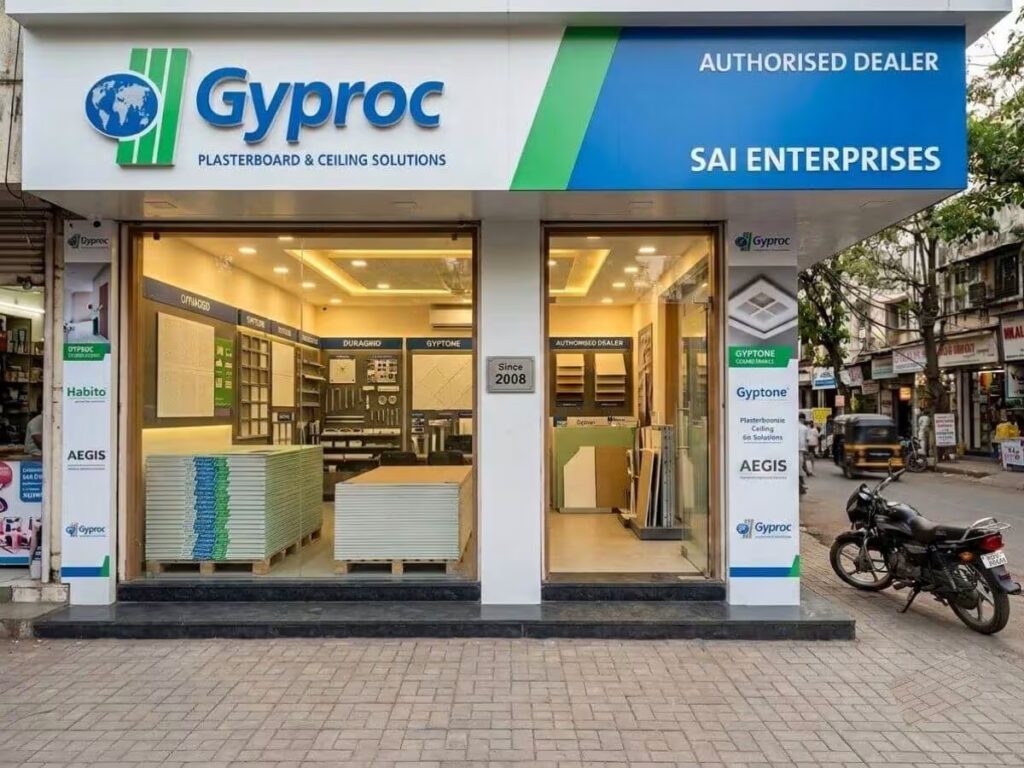
If you have been exploring building material businesses, a Gyproc dealership is one of those opportunities that quietly rewards patient investors who understand their local market.
But before you make any move, you need the full picture — the real cost, the investment structure, and what it actually takes to run this business day-to-day.
In this post,
What Is Gyproc and Why Is the Demand So Strong
Gyproc is a brand name that has become synonymous with gypsum plasterboards in India — much like “Xerox” for photocopying or “Fevicol” for adhesive. It is manufactured by Saint-Gobain, one of the world’s largest construction materials companies, and its products are used in millions of construction projects across India and globally.
In India, Gyproc is the market-leading brand for gypsum plasterboards and associated systems. The product range covers gypsum ceiling tiles, plasterboards, metal framing systems, acoustic ceiling tiles, drywall solutions, and gypsum plastering — making it a one-brand solution for most interior construction needs.
The India gypsum board market size is projected to reach USD 1,575 million by 2033, growing at a CAGR of 4.80% during 2025–2033.
Rapid urbanisation, rising residential and commercial construction, and growing demand for cost-effective, lightweight, and fire-resistant building materials are supporting market demand. Government initiatives promoting infrastructure development are further supporting growth across Tier I and Tier II cities.
Simply put, the pie is getting bigger every year — and dealers sitting in the right location with the right stock are the ones collecting the margin.
The Gyproc Dealer vs. Distributor Structure
Before we get into rupees and square footage, you need to understand where you fit in the supply chain.
Distributors sell products with exclusive rights within a particular territory or region. Dealers purchase these products from the distributors and sell them directly to end customers.
In the Gyproc ecosystem, Saint-Gobain appoints regional distributors in major cities and states. Dealers then source from these distributors and sell to contractors, interior designers, builders, and retail customers. As a new entrant, you will most likely start as a dealer, building volume, relationships, and market presence — before potentially graduating to a distributor role in an underserved territory.
Saint-Gobain Gyproc India has offices in Mumbai, Ahmedabad, Bengaluru, Chandigarh, Chennai, Coimbatore, Noida, and other major cities. Your application and onboarding typically happen through the nearest regional office, and the company evaluates your financial capacity, storage infrastructure, and local market knowledge before approving you.
Gyproc Dealership Cost
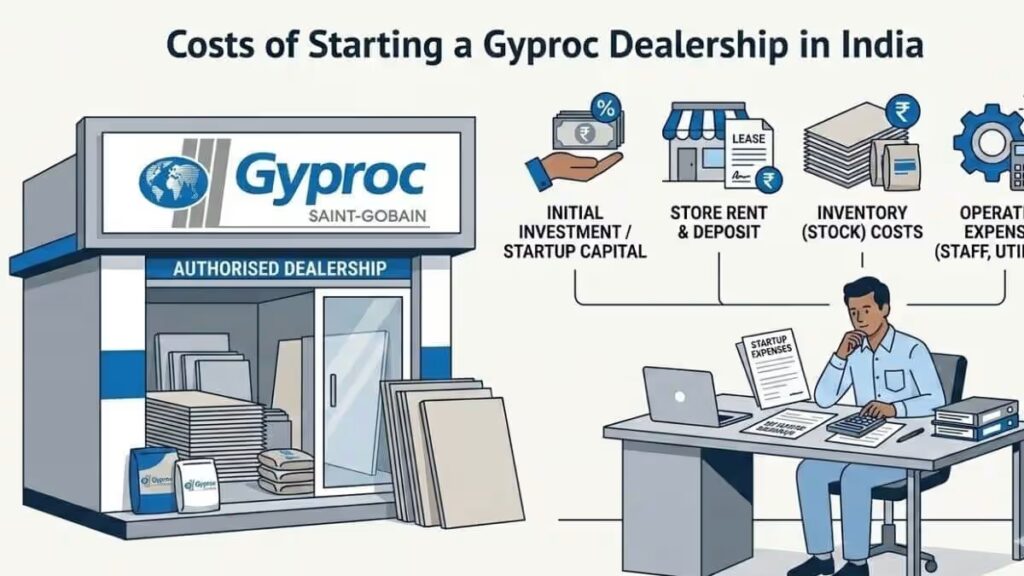
This is where most people want to get straight to the point, and fairly so. The total investment for a Gyproc dealership depends on whether you are in a metro city, a Tier 2 town, or a smaller district — but let us look at the key cost heads.
1. Initial Stock Investment
This is your single largest upfront cost. Gyproc boards come in various types — standard gypsum wallboards, moisture-resistant boards, fire-rated boards, acoustic ceiling tiles, and more. On average, a Gyproc ceiling installation costs around INR 70 per sq. ft. — which gives you an idea of the product price band at the retail end.
For a dealer opening with a reasonable range, a starting stock investment of ₹5 lakh to ₹15 lakh is realistic for a small-to-mid setup, covering boards in multiple SKUs, metal framing accessories, and jointing compounds. In high-volume metro locations, this initial stock requirement can climb higher depending on the territory size and targets set by the company.
2. Warehouse and Storage Space
Gypsum boards are large-format products, typically 4 ft x 6 ft or 4 ft x 8 ft, and they need to be stored flat, off the ground, and protected from moisture. You cannot run this business from a small room.
A functional Gyproc dealership needs a minimum covered warehouse space of around 1,000–2,000 sq. ft. for a small operation, going up to 3,000–5,000 sq. ft. for a distributor-level setup. The monthly rent for this space varies wildly — ₹15,000–₹40,000 in Tier 2 cities, and significantly higher in metros.
3. Security Deposit
Most building material companies ask for a refundable security deposit when appointing a dealer or distributor. For Gyproc dealerships, this typically ranges from ₹1 lakh to ₹3 lakh, depending on your territory and credit terms.
4. Working Capital
This is the cost most first-time dealers underestimate. You will need funds to replenish stock before you collect payment from your customers. Contractors often work on credit terms of 30–60 days. A comfortable working capital buffer of ₹3 lakh to ₹8 lakh keeps the business running without cash flow stress, especially in the initial 6–12 months.
5. Vehicle and Delivery Cost
Gyproc boards need careful transportation — they cannot be thrown into any vehicle. A delivery tempo or a tie-up with a dedicated logistics provider is necessary. If you are hiring transport, keep a monthly logistics budget of ₹10,000–₹25,000 depending on your delivery volume. Purchasing a mini-truck outright adds another ₹4–₹8 lakh to your upfront investment, though many dealers start with hired vehicles.
6. Staff and Operations
You will need at least one or two people for sales, warehouse management, and billing. Salaries, basic office infrastructure, and software for billing and inventory can add up to ₹25,000–₹60,000 per month for a small team.
Summary — Total Investment Range
| Cost Head | Estimated Range |
| Initial Stock | ₹5 lakh – ₹15 lakh |
| Security Deposit | ₹1 lakh – ₹3 lakh |
| Warehouse (6 months’ rent) | ₹1 lakh – ₹3 lakh |
| Working Capital Buffer | ₹3 lakh – ₹8 lakh |
| Logistics Setup | ₹1 lakh – ₹2 lakh |
| Miscellaneous Setup | ₹50,000 – ₹1 lakh |
| Total Estimated Investment | ₹12 lakh – ₹32 lakh |
Small-town dealers on the lower end, metro or large-city dealers on the higher end — and if you are going for a full distributor appointment with exclusive territory rights, plan for ₹25–₹50 lakh and above.
How Much Can You Earn — Margins and Profitability
Dealer margins in the building materials space are not flashy, but they are steady. A Gyproc dealer typically earns a gross margin of 8–15% on sales, depending on volume, product mix, and the commercial terms negotiated with the distributor or the company.
On higher-value products like acoustic tiles or specialty boards, margins tend to be slightly better. The more you sell, the better pricing you unlock. The gypsum board business confirms strong profitability potential even at moderate utilisation levels.
A dealer doing ₹15–₹20 lakh in monthly sales at a 10% margin is looking at ₹1.5–₹2 lakh in gross profit per month — before expenses. Net take-home after rent, staff, and logistics would realistically be ₹60,000–₹1.2 lakh per month for a small-to-mid-sized dealership in a decent market. Volume is the game here.
Documents Required to Apply
Common documents include PAN, KYC, GST/business details where applicable, bank details, address proof, and information about your business, warehouse, and distribution infrastructure. You will also need to show proof of warehouse space — either an ownership document or a registered lease agreement.
A Sole Proprietorship or Private Limited Company registration is acceptable. GST registration is mandatory for any dealership business in India.
How to Apply — The Step-by-Step Process
The cleanest way to start is directly through the official Gyproc channel.
Saint-Gobain India Pvt Ltd – Gyproc Business can be contacted via toll-free number 1800-102-7897 or by email at gyprocindia@saint-gobain.com. You should reach out to the nearest regional office, express your interest in a dealership, and the local sales team will guide you through their current territory openings and requirements.
The verification process typically covers your business, financial capacity, infrastructure, and market experience. Companies are selective about who they appoint — they want dealers who have the capital to hold stock, the local connections to push sales, and the discipline to maintain credit terms.
This is not a passive income business. The margins reward those who actively network with contractors, builders, interior designers, and real estate developers in their area.
Commercial spaces including shopping malls, corporate offices, and educational institutions require high-quality interiors, and gypsum board applications in these structures help improve acoustics and provide a polished finish. If you are in a city or town where construction activity is visible and real — this is a product that will keep selling.
India’s government-backed housing schemes add steady baseline demand, meaning even outside of premium construction, the market for affordable gypsum board applications is expanding. As a dealer in the right geography, you benefit from both the premium and the volume segments.
The Gyproc brand does a lot of the trust-building for you. Your job is to be available, reliable, and well-stocked.

Suraj Shetty
Suraj Shetty has over 8 years of experience in small business, startups, and business consulting. He shares practical insights and proven strategies to help entrepreneurs discover new opportunities and grow their businesses sustainably.
Kaushik Nitin
30 years of experience in business consulting across diverse industries