Rice is not just food in India — it is daily life for more than 60 percent of the population. Rice is not merely a crop here; it is the backbone of how half of India eats every single day.
Yet, most of the rice that reaches your plate has passed through the hands of a rice miller — someone who invested, risked, and built a business around one of the most reliable demands in this country.
If you have been thinking about starting a rice mill, you are looking at a business that does not depend on trends, viral marketing, or seasonal luck. The demand is structural. The raw material is available across nearly every state.
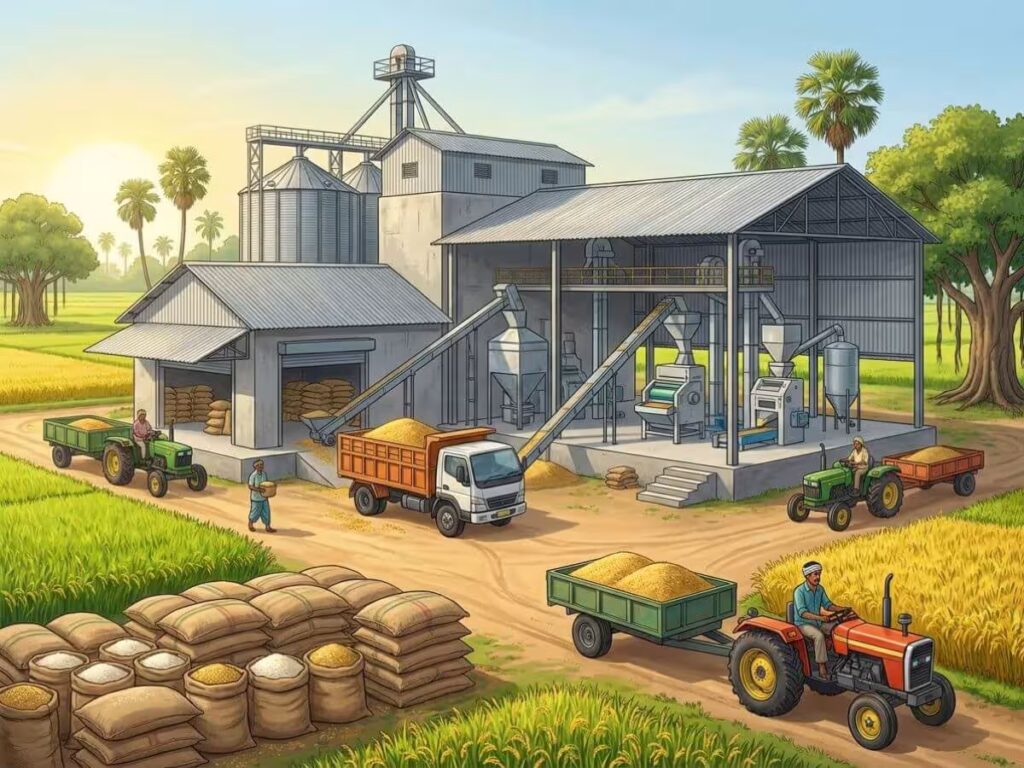
The government supports through schemes like PMEGP and PMFME has made the entry more accessible than it has ever been.
That said, knowing exactly how much it costs to set up a rice mill in India — and where each rupee actually goes — is where most people struggle. This article breaks it all down clearly, so your investment decisions are based on facts, not guesswork.
In this guide,
How Much Does It Cost to Start a Rice Mill in India?
The total investment depends almost entirely on the scale you choose. For a small-scale mill processing 1 to 2 tonnes of paddy per hour, the total setup cost typically falls between ₹10 lakh and ₹25 lakh. This is the sweet spot for most first-time entrepreneurs — manageable risk, reasonable output, and enough room to grow.
A medium-scale mill with a 2 to 5 tonne per hour capacity requires roughly ₹25 lakh to ₹1 crore. Once you move to large-scale, fully automated plants — above 5 tonnes per hour — you are looking at ₹1 crore to ₹5 crore or more, depending on the type of rice being processed (raw, steam, or parboiled) and the level of automation.
For anyone starting out, the 1-2 TPH small-scale setup is the most sensible entry point. It keeps your exposure manageable and gives you time to understand the market before committing bigger capital.
Land and Building Cost
Land is the most variable cost in the entire setup. In rice-growing states like Uttar Pradesh, Bihar, Chhattisgarh, Odisha, and West Bengal, semi-rural land can be acquired at far more reasonable rates than in peri-urban areas. Depending on location, expect land purchase costs between ₹5 lakh and ₹20 lakh for a workable plot. For beginners, leasing land is usually the wiser move — it saves capital for machinery and working capital, which are far more critical in the early months.
On the construction side, a small-scale rice mill typically needs 1,500 to 3,000 square feet. This space must accommodate the processing machinery, paddy storage, finished goods godown, and a small office.
Basic industrial shed construction in rural or semi-urban areas runs between ₹800 and ₹1,200 per square foot, which means budgeting ₹12 lakh to ₹24 lakh just for the building. Many entrepreneurs today are choosing Pre-Engineered Buildings (PEB), which can reduce construction costs by 25 to 30 percent compared to traditional RCC construction — and they come up significantly faster, which means you can start generating revenue sooner.
Rice Mill Machinery Price
Machinery is the biggest single item in your budget, often accounting for 40 to 60 percent of total project cost. A standard rice milling setup requires a paddy pre-cleaner, rubber sheller or dehusker, paddy separator, rice whitener or polisher, and a grader. Medium and large-scale mills also include a colour sorter or sortex machine for quality control, plus a packaging unit.
For a 1-tonne-per-hour raw rice mill, the full machinery package costs approximately ₹8 to ₹13 lakh. The same capacity in a steam or parboiled configuration — which needs a boiler and additional tanks — costs ₹12 to ₹18 lakh. A 2-tonne-per-hour semi-automatic mill typically runs ₹18 to ₹30 lakh in machinery. Move to a 5-tonne-per-hour automatic parboiled plant, and the machinery cost climbs to ₹45 to ₹70 lakh.
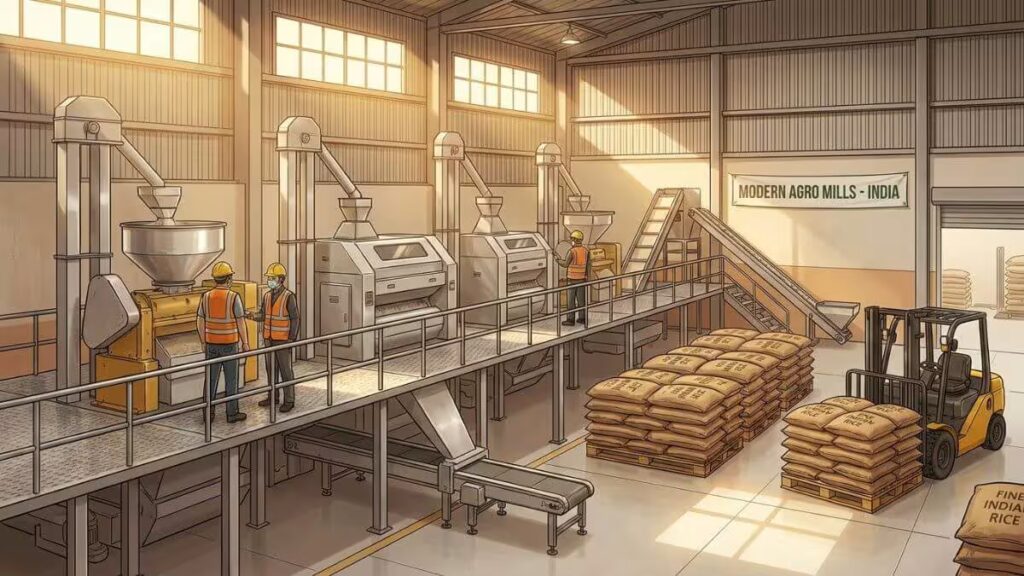
These figures cover the machines themselves. Electrical setup — transformer, motors, wiring, and control panels — adds another ₹2 to ₹5 lakh for small units. Installation and commissioning charges from the machinery supplier can add ₹50,000 to ₹1.5 lakh on top of that. Always clarify what is and what is not included in your machinery quote before finalising anything.
One more thing — do not make the mistake of choosing the cheapest machine available. Reliable after-sales service and easy availability of spare parts matter enormously when your machine goes down in the middle of a harvest season.
Working Capital Required
Many new entrepreneurs plan carefully for the setup cost but completely underestimate how much running the mill day-to-day actually demands. Working capital — mostly paddy procurement — is where most people get caught short.
Paddy is the raw material, and it dominates your operational budget. The government’s Minimum Support Price (MSP) for common paddy is around ₹2,300 per quintal. A 1-tonne-per-hour mill operating 8 hours per day processes approximately 25 to 30 tonnes of paddy per month. That raw material cost alone comes to ₹5.75 lakh to ₹6.9 lakh every single month.
Add to that the wages for 4 to 6 workers — roughly ₹60,000 to ₹90,000 per month — plus electricity for your industrial connection (₹25,000 to ₹50,000 monthly), packaging materials, maintenance, and miscellaneous costs. Your total monthly running expenses for a small-scale unit will typically fall between ₹8 lakh and ₹12 lakh.
You should have at least 2 to 3 months of working capital ready before you switch the machines on. Paddy prices fluctuate seasonally, and a sudden squeeze on working capital at the wrong time can derail an otherwise good setup.
The Profit you can Expect
A well-managed small- to medium-scale rice mill in India typically earns a net profit margin of 8 to 15 percent. For a unit processing 25 to 30 tonnes of paddy per month, that translates to a monthly profit of roughly ₹60,000 to ₹1.5 lakh in the early years, improving steadily as operations become more efficient and buyers are established. ROI usually comes within 2 to 4 years.
The commodity rice market runs on thin margins. The real opportunity lies in moving up the value chain — branding your rice, targeting institutional buyers like hotels, hospitals, and school mid-day meal programmes, exploring export markets in the Gulf and Southeast Asia, or simply managing by-products efficiently.
If you are only thinking about selling polished rice, you are leaving significant money on the table. Rice milling produces three valuable by-products — rice bran, rice husk, and broken rice — and smart mill owners monetise all three.
Rice bran is in steady demand from edible oil extraction units and animal feed manufacturers. Husk is sold as biomass fuel to brick kilns, industrial boilers, and power plants — and some millers even redirect it to reduce their own electricity bills.
Broken rice finds buyers in poultry farms, food processors, distilleries, and animal feed manufacturers. By-product income can add up to 10 to 20 percent of your total mill revenue, with zero additional raw material cost. At tight margins, this extra stream is not a bonus — it is often what keeps a small mill profitable.
Licences Required
The paperwork side of this business is unavoidable, though not as complicated as many assume. FSSAI (Food Safety and Standards Authority of India) registration is mandatory — it is the baseline licence for any food processing unit. A basic registration for small units is inexpensive; a state-level or central licence costs ₹2,000 to ₹7,500 per year.
Udyam Registration on the government’s Udyam portal is free and should be your very first step. Without it, you are ineligible for nearly every subsidy, loan scheme, or government support available to you. GST registration is required once your turnover crosses the applicable threshold. Importantly, paddy and unbranded rice both attract 0% GST, which keeps your core business clean from a tax standpoint.
A Factory Licence from the State Labour Department is needed if you employ above a certain number of workers — check your state’s specific threshold. You will also need a Pollution Control NOC from your State Pollution Control Board, since rice milling generates husk dust and bran particles. Apply for this early, as timelines vary by state. All told, licences, fees, and initial registration costs should fall between ₹30,000 and ₹1 lakh.
Government Schemes Available
This section can genuinely change your financial math, so pay attention.
The PMEGP — Prime Minister’s Employment Generation Programme — is the most widely used scheme for rice mill entrepreneurs. It provides a capital subsidy of 15 to 35 percent of the project cost, with the higher rates going to rural and SC/ST/women applicants. Banks fund 90 to 95 percent of the total project, and your own contribution can be as low as 5 to 10 percent. The maximum eligible project cost for manufacturing units is ₹50 lakh. So a ₹25 lakh project could get you a subsidy of ₹6 to ₹8 lakh — not a small amount.
The PMFME Scheme (PM Formalisation of Micro Food Processing Enterprises) specifically targets micro food processing units, which include small rice mills. It offers a 35 percent credit-linked capital subsidy on eligible project costs.
NABARD supports agro-processing units through the Agriculture Infrastructure Fund with interest subvention on loans. They have also recently revised their warehouse construction subsidy — as of November 2024, the permissible cost for godown construction has been doubled from ₹3,000 per MT to ₹6,000 per MT, meaning eligible millers can now claim significantly higher subsidies on storage infrastructure.
For very small units needing working capital support, the Mudra Loan scheme — under the Kishore and Tarun categories — can provide up to ₹10 lakh with relatively straightforward processing.
For all of these, your Udyam registration must be active, and you will need a well-prepared Detailed Project Report (DPR). A weak or incomplete DPR is the most common reason loan and subsidy applications get rejected. It is worth spending a small amount on professional help to get this right.
India has over 50,000 operational rice mills, but the market for quality-branded, hygienic, consistently-packaged rice is still wide open. The demand is not going anywhere. The government support is real and well-structured. For someone willing to plan carefully, execute patiently, and think beyond just bulk trading, the rice mill business remains one of the more stable and scalable small business options available in India today.

Suraj Shetty
Suraj Shetty has over 8 years of experience in small business, startups, and business consulting. He shares practical insights and proven strategies to help entrepreneurs discover new opportunities and grow their businesses sustainably.
Anoop Dewan
20 years of experience in Entrepreneurship