India’s love affair with plants is no longer just seasonal. In residential colonies, you will spot window sills lined with money plants, balconies loaded with succulents, and kitchen gardens growing quietly behind apartments.
Add to that the millions of farmers who rely on professional nurseries for disease-resistant seedlings every season, and what you have is a business opportunity that is both evergreen and expanding.
Starting a plant nursery is one of those rare businesses where you can begin small enough to fit in your backyard and scale large enough to supply entire districts.
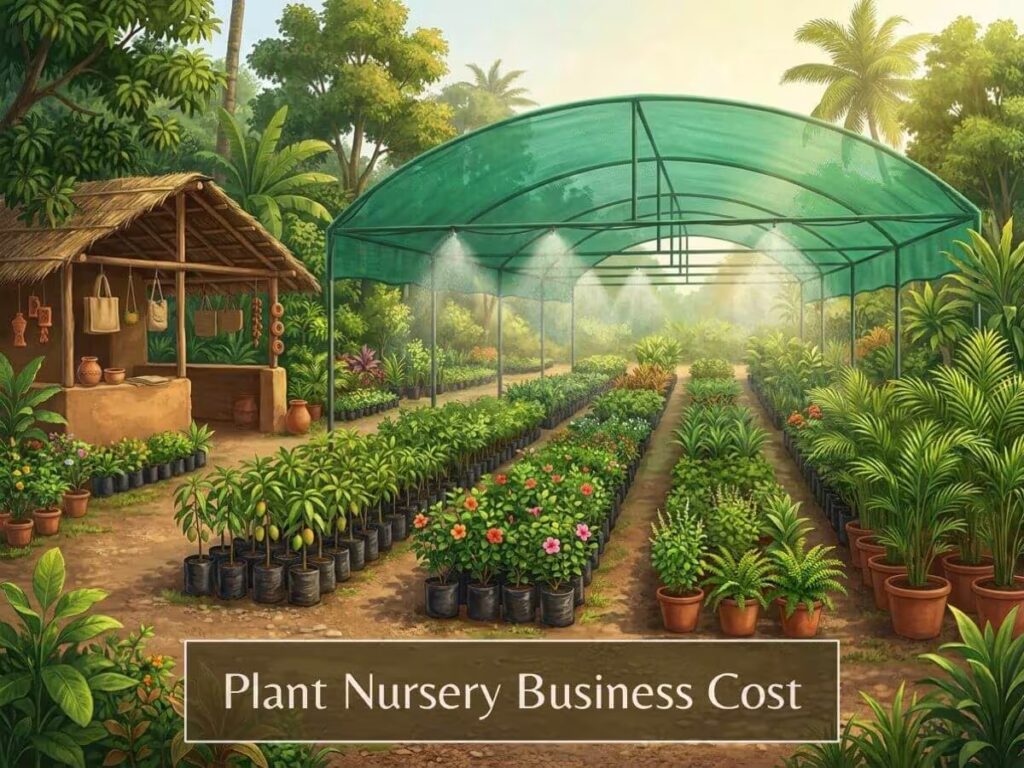
But before you dig your hands into the soil, you need to understand exactly what the costs look like, where your money goes, and how long it takes to see returns.
In this post,
What Kind of Plant Nursery Can You Start in India?
The first thing to sort out is what type of nursery you want to run, because this decision shapes every cost that follows.
A retail nursery is the most familiar setup — a physical space selling ornamental plants, indoor plants, flowering plants, and herb kits directly to walk-in customers. A wholesale or seedling nursery produces large volumes of vegetable seedlings (tomato, chilli, muskmelon, watermelon) and sells them in bulk to farmers and agri-input dealers.
Then there is the specialty nursery, which focuses on high-value niches like grafted plants, succulents, medicinal plants such as ashwagandha and tulsi, or exotic bonsai. Finally, a home-based terrace nursery is the entry-level option, perfect for beginners who want to test the market before committing serious capital.
Each model has a different cost structure, different customers, and a different path to profit.
How Much Does It Cost to Start a Plant Nursery?
The cost to start a plant nursery depends entirely on your scale and location. In Tier 1 cities like Delhi, Mumbai, and Bengaluru, setting up a plant nursery can cost anywhere between ₹15 lakh and ₹80 lakh.
In Tier 2 cities like Jaipur, Indore, and Coimbatore, the range is typically ₹8 lakh to ₹45 lakh. In Tier 3 cities and smaller towns, a functional setup can be launched for ₹4 lakh to ₹30 lakh.
For a home-based or terrace nursery, the investment can be as low as ₹50,000. For a small home-based nursery, the minimum initial investment starts from ₹1 lakh, while a commercial unit can require up to ₹10 lakh for land, tools, and plants. Once you move into polyhouse territory for seedling production, the numbers climb significantly.
Land and Infrastructure
Land is your single biggest cost variable. If you own the land, you save substantially. If you are renting, budget between ₹10,000 and ₹50,000 per month, depending on the city and plot size.
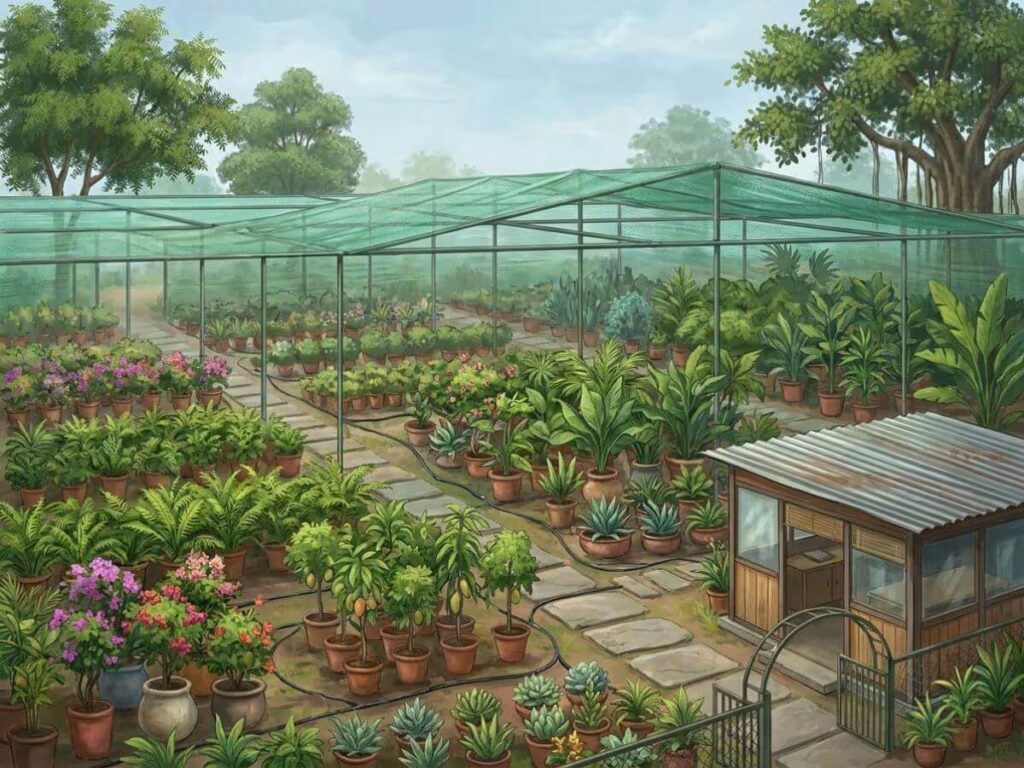
For the physical structure, shade net houses that protect and grow young plants typically cost ₹50 to ₹250 per sq ft, which means a 1,000 sq ft setup runs between ₹50,000 and ₹2.5 lakh. If you want year-round production, polytunnels and polyhouses cost around ₹200 to ₹350 per sq ft.
For those planning a full-scale seedling nursery, building a polyhouse on one acre of land costs around ₹40 lakh, and for a shade net house, it is approximately ₹28 lakh. With state government subsidies ranging from 40% to 60%, your actual out-of-pocket expense for a polyhouse comes down to around ₹20 lakh, and for a shade net house to ₹14 lakh.
Beyond the structure, you need to budget for irrigation. A drip or sprinkler system, or even a basic tank and pump setup, will cost you between ₹30,000 and ₹1.5 lakh. Potting mix, soil, cocopeat, and compost add another ₹10,000 to ₹60,000 to your initial outlay.
Plant Stock, Tools, and Equipment Costs
Once the infrastructure is in place, you need to stock up. Seeds, cuttings, rootstocks, and grafts will cost between ₹10,000 and ₹1.5 lakh, depending on the variety and quantity. Rare or grafted varieties obviously cost more than common ones.
Initial plant procurement for a commercial nursery can range from ₹3 lakh to ₹15 lakh, depending on the size and plant variety. It is advisable to start with high-turnover varieties — ornamental plants, seasonal flowering plants, money plants, succulents, and vegetable seedlings — before diversifying into expensive exotic stock.
Basic tools like pruners, spades, watering cans, and sprayers will run you ₹10,000 to ₹30,000. Fertilizers, organic manure, pesticides, and fungicides are recurring costs that typically come to ₹5,000 to ₹20,000 per month, depending on your scale.
Monthly Running Costs of a Plant Nursery
Once your nursery is up and running, the recurring costs determine your actual profitability. Here is a realistic picture for a small to mid-scale operation.
Labour is typically the largest monthly expense. Wages for skilled staff like horticulturists and gardeners range from ₹15,000 to ₹50,000 per month. For a small nursery, one or two helpers at ₹10,000 to ₹15,000 each is a reasonable starting point. Water and electricity bills add another ₹3,000 to ₹8,000 per month. Fertilizers and pest control are another ₹5,000 to ₹15,000. Transportation for deliveries can be ₹3,000 to ₹10,000 per month.
All said, a small to mid-scale nursery should budget ₹30,000 to ₹60,000 per month for running costs, excluding loan repayments.
How Much Profit Can a Plant Nursery Make?
For a small commercial nursery selling around 20,000 mixed saplings a year at ₹30 each, the revenue comes to ₹6 lakh. Add retail sales of potted plants, herb kits, and indoor plants — that is another ₹3 lakh. Factor in a landscaping contract or two, and you are looking at roughly ₹10.5 lakh in annual revenue. After recurring expenses of around ₹8 lakh, the net profit before tax is approximately ₹2.4 lakh.
Scale it up to a one-acre polyhouse running seedling production, and the numbers change dramatically. In a one-acre polyhouse setup growing crops like watermelon, muskmelon, chilli, and tomato seedlings, you can prepare around 15 lakh plants per batch, and each batch takes about one to one and a half months. At a net profit of ₹0.20 per plant, and accounting for realistic losses, you can earn a net profit of approximately ₹2.5 lakh per batch. With four batches a year, that adds up to ₹10 lakh in annual net profit.
Most nurseries reach breakeven within 12 to 24 months. Specialty nurseries dealing in orchids, grafted fruit varieties, or high-end landscaping plants often see faster returns due to higher margins.
Licences and Registrations You Will Need
The compliance side of a nursery business is simpler than most people expect. You will need a nursery licence from your state’s horticulture department (usually around ₹500). Registering your business as a proprietorship or partnership firm is straightforward. GST registration is required only if your annual turnover exceeds ₹20 lakh, and you will also need a trade licence and municipal permit depending on your location.
Getting Udyam registration as an MSME is highly recommended — it unlocks access to government subsidies and bank loans at preferential rates. Listing your nursery on the National Nursery Portal is optional but gives credibility and visibility, especially if you want to supply to government projects.
Government Schemes to Reduce Your Investment
The Mission for Integrated Development of Horticulture (MIDH) is the most significant scheme available. Under MIDH, private hi-tech nurseries can receive a 40% subsidy, credit-linked and back-ended, with a maximum limit of ₹40 lakh per unit. For states in the Northeast, hilly, and Himalayan regions, the subsidy goes up to 50%. This means for a ₹50 lakh polyhouse setup, you effectively bring your investment down to ₹30 lakh after the government subsidy.
The National Horticulture Board (NHB) offers 25% to 40% capital subsidies on greenhouse and polyhouse setups and is particularly useful for retail ornamental nurseries looking to build quality infrastructure.
For working capital and smaller setups, a Mudra Loan under the Kishor or Tarun category can get you between ₹5 lakh and ₹10 lakh without collateral. NABARD’s Rural Infrastructure Development Fund (RIDF) is another avenue for those setting up nurseries in rural areas with infrastructure tied to agriculture.
Do speak to your nearest Krishi Vigyan Kendra (KVK) or the district horticulture office — they can guide you through the application process and also connect you to state-specific schemes that many people simply are not aware of.
If you are willing to put in the first one to two years of hard work. The demand for plants in India is not going away. Urban consumers want greenery, farmers need quality seedlings, and landscaping companies are growing alongside the real estate boom. The business rewards those who maintain plant quality and build steady customer relationships.
Choose your niche wisely, and make use of the government subsidies available. A plant nursery is one of those businesses where patience and love for the craft are just as valuable as capital.

Suraj Shetty
Suraj Shetty has over 8 years of experience in small business, startups, and business consulting. He shares practical insights and proven strategies to help entrepreneurs discover new opportunities and grow their businesses sustainably.
Kaushik Nitin
30 years of experience in business consulting across diverse industries