
Last Updated on December 27, 2025 by Suraj Shetty
Solar is buzzing in India, and Goldi Solar is one of the homegrown module makers scaling fast.
The government is also pushing renewable energy goals, and the public is becoming more aware of renewable energy.
If you have a bit of capital, a local market presence, and an interest in the solar industry, then starting a Goldi solar dealership is a good option.
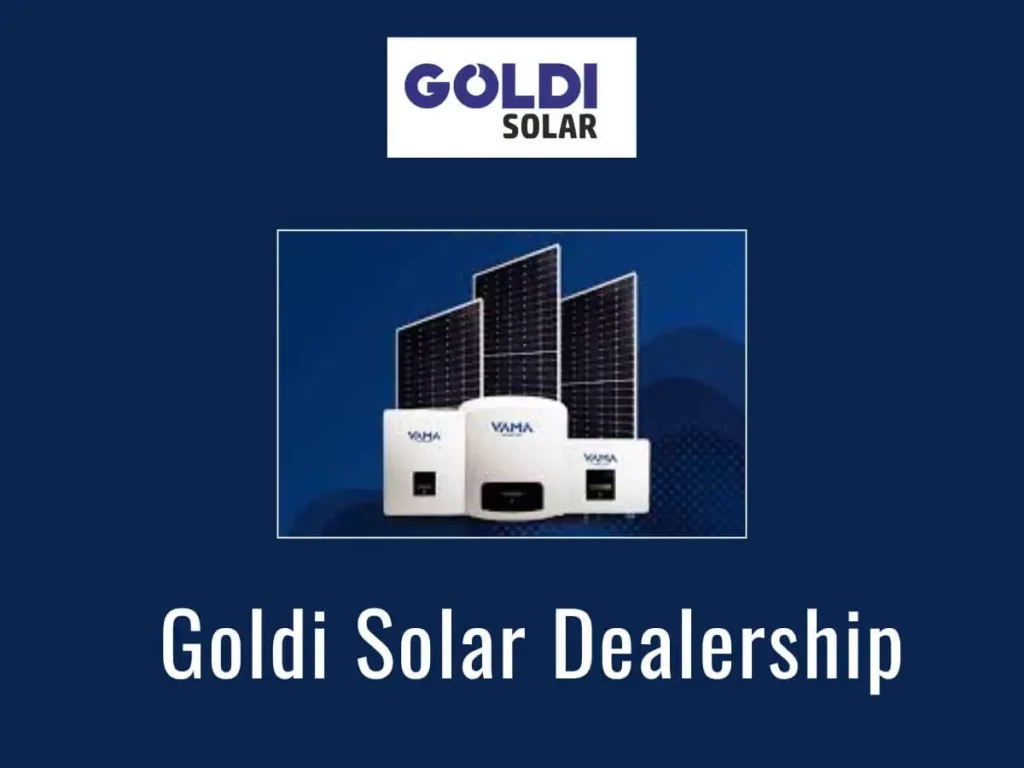
In this article, I will explain everything about the Goldi Solar dealership — how to apply, investment required, dealership cost, profit margin, and some tips to grow your business.
In this post,
Why Choose Goldi Solar?
Goldi Solar is an Indian PV module manufacturer and EPC player that has been rapidly expanding its manufacturing capacity and dealer network.
The brand actively invites channel partners — from local dealers to regional distributors — and runs sign-up campaigns for new partners.
Their main manufacturing plant is located in Gujarat, and they have an overall 14.7 GW annual module manufacturing capacity across their plants.
Goldi Solar isn’t just making one kind of panel — they have a diverse range, and they’re innovating:
➡︎ HELOC® Pro series: Their flagship line includes high-efficiency panels like GS10-M144 (525–540 Wp), 132-cell (480–500 Wp), 120-cell (435–450 Wp), and 108-cell (390–405 Wp).
➡︎ Mono-cell panels: They manufacture mono-crystalline panels up to ~400 Wp.
➡︎ Poly-cell panels: They have polycrystalline modules up to ~335 Wp.
➡︎ High-tech modules: They are also launching advanced modules, like an HJT-based (heterojunction) 710 W panel, which is very cutting-edge.
Goldi Solar Dealership Cost
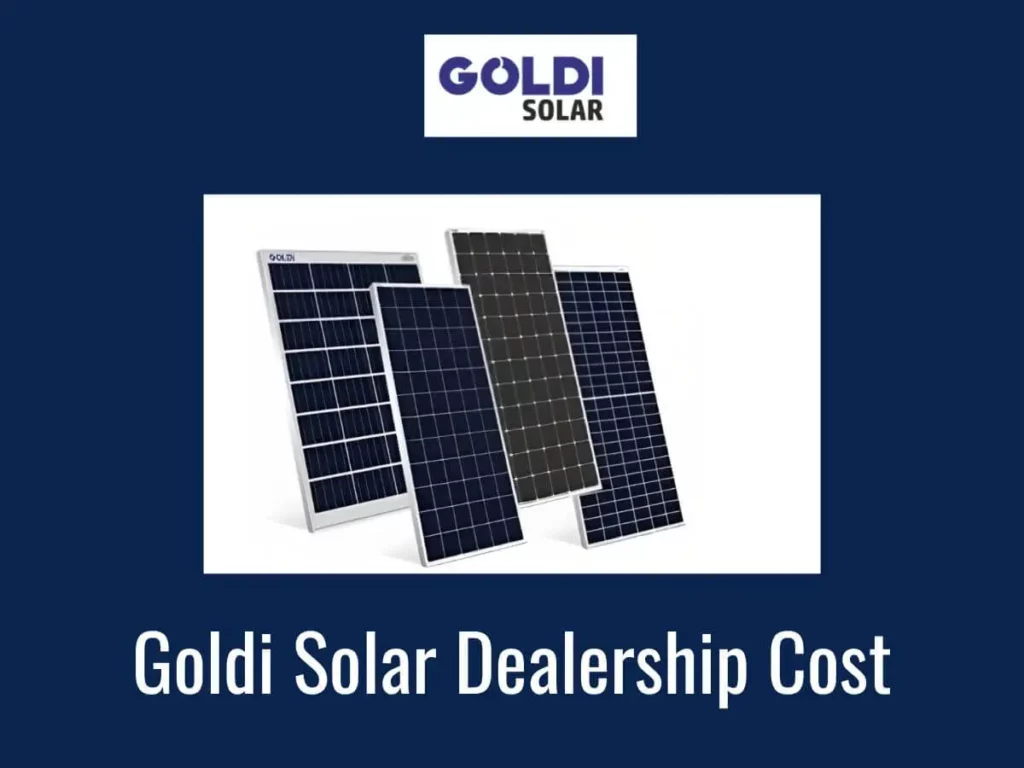
Goldi recruits channel partners and promotes low-entry options. But the company doesn’t publish a single flat “dealership fee” publicly.
Their terms depend on region, dealership type (dealer vs distributor), MOQ, and stock commitments. For that reason, you should request Goldi’s partner kit via their channel.
Based on industry norms for Indian solar dealerships and franchise programs, we can approximately estimate the Goldi Solar dealership cost as below,
Small local dealer (retail + demo stock; no heavy warehousing):
Investment required: ₹2 lakh – ₹6 lakh (approx.)
This covers a small shop setup, demo panels, initial working capital, basic tools, and marketing. (Estimate)
Regional distributor (warehouse, bigger MOQ, logistics):
Investment required: ₹8 lakh – ₹25 lakh+ (approx.)
Depending on the required purchase commitments, transport, and staffing. (Estimate)
EPC/integrator (if you’ll install):
Additional investment for tools, vehicles, and trained manpower can push the total initial cost higher.
Goldi may offer credit terms or low-investment entry schemes at different times. So you should always ask the company for the latest partner program details.
Profit Margin in Goldi Solar Dealership
The profit margin in Goldi solar dealership depends a lot on product mix (panels vs inverter vs services), region, and your value-add (installation, AMC, rooftop integrator).
In the dealer/franchise model, the gross margins are in the ~10%–25% range on hardware and higher on services (installation + AMC).
In residential EPCs, normally, the net margins are in the mid-teens after operating costs. These are industry averages — your own margins will depend on volume, negotiating power, and whether you add installation/AMC revenue.
Simple assumption (for clarity):
➡︎ Sell a 3 kW residential rooftop system price to the customer: ₹1,20,000 (example).
➡︎ Your landed cost for hardware (panels + inverter + mount + cables): ₹1,00,000.
➡︎ Gross on hardware = ₹20,000 → ≈16.7% gross margin.
➡︎ Add installation/service charges (say you charge ₹15,000, of which ₹8,000 is labor and ₹7,000 is net service margin) → net on project increases.
➡︎ Annual maintenance contracts, battery retrofits, and referrals significantly improve lifetime profitability.
This is an example; the real numbers will vary by brand, city, and product model. You can keep the margins healthy by combining product sales with recurring service income.
In the Solar panel dealership, the real profit comes from below services,
- Service & installation fees — Normally better margins than hardware.
- AMCs and maintenance — This is a recurring revenue.
- Value-added services — Like rooftop assessments, financing facilitation, battery retrofits, and net-metering paperwork assistance.
- Volume discounts — As you grow, negotiate better rates from the manufacturer/distributor and increase your profits.
How to get a Goldi Solar dealership
1. Decide your business type
➡︎ Dealer/retailer — Sells to end customers, small stocking, focuses on local residential/commercial projects.
➡︎ Distributor/wholesaler — Larger orders, supplies multiple dealers/resellers; needs bigger capital and logistics.
➡︎ EPC/Integrator — Handles design + installation; combines product sales with services and AMCs (annual maintenance contracts).
Choose your business type based on capital, local demand, and how much technical/installation work you’ll do.
2. Get official terms from Goldi
Goldi Solar publicly lists a dealer/distributor inquiry channel and a toll-free contact. You can contact them to request their dealership/distributor kit and the latest terms for your region.
Making that direct call/email is the best first move because exact terms (minimum order quantities, credit terms, marketing support) change over time.
Goldi provides partner signup info and also promotes “low investment” entry-level options — but these details will come from their sales team.
3. Legal & paperwork
Register your business (proprietorship/LLP/Pvt Ltd), get GST registration, open a current bank account, and prepare KYC documents.
If you plan to do installations, ensure you follow local electricity board/municipal rules and get any required licenses or vendor approvals.
4. Location, stock & inventory
➡︎ Small dealer: a 150–300 sqft shop + demo panels and a small stock of popular panels & inverters.
➡︎ Distributor: warehouse space, handling equipment, and transport ties.
You should stock panels smartly- inverters, mounting structure, cables, earthing kits, and a list of vetted installers. You should not overstock slow-moving items. The solar module prices can fluctuate.
5. Technical training & after-sales
You can get technical training from Goldi (ask about it) or use online certifications. After-sales and warranty support are most important in this business. Make proper processes for warranty registration, customer handover, and AMCs.
6. Sales funnel & marketing
For sales and marketing, you can use different paths,
➡︎ In offline, you can try local dealer referrals, builder/contractor tie-ups, displays at your shop, and attendance at local trade shows.
➡︎ Online, you can try Google Business profile, short explainer videos, WhatsApp business broadcasts, and local Facebook/Instagram targeting.
You can also offer site surveys and free estimates. This helps residential customers, as they can compare a few quotes from different vendors.
Who can become a Goldi Solar Dealer?
To get a Goldi Solar dealership, you don’t need to be an electrical engineer. But you should have some basic things like,
➡︎ Some local market sense (who in your town buys rooftop solar, shops, small industries).
➡︎ A basic office/storefront or warehouse (for stock & display).
➡︎ Willingness to do sales + oversee installations (or network with an installer).
➡︎ GST registration, current account for business, PAN, and basic business documentation (identity, address, shop lease).
Goldi’s dealer/distributor model targets entrepreneurs who can handle procurement, sales, and after-sales in their territory.
In this business, the margins on hardware alone are not too high, so you have to focus on services, recurring maintenance, and building local trust.
It is better if you have a financing partners. Because many customers prefer EMI/loan options. You can tie up with NBFCs or banks.
You should keep warranty & replacement paperwork clear. Here, the product warranty handling is most important for brand reputation. Goldi offers standard warranties on modules, so follow their registration process.

Suraj Shetty
Suraj Shetty has over 8 years of experience in small business, startups, and business consulting. He shares practical insights and proven strategies to help entrepreneurs discover new opportunities and grow their businesses sustainably.