
Solar energy is no longer just a government initiative in India — it’s a real business opportunity knocking at the door of everyday entrepreneurs.
Adani Solar is one of the most recognized names in India’s renewable energy space. Backed by the Adani Group — one of the country’s largest conglomerates — this brand carries serious weight.
So it’s no surprise that more and more small business owners across Tier 2 and Tier 3 cities are planning to start an Adani Solar dealership.

Adani Solar is India’s first and largest vertically integrated solar PV manufacturer, operating out of Mundra, Gujarat. Their manufacturing capacity currently stands at 4 GW for cells and modules, with ambitious plans to scale to 10 GW.
All their products are MNRE-approved and comply with BIS, IEC, and ALMM certifications — which matters enormously if you’re planning to work with government tenders or subsidy-linked projects.
The demand story is compelling, too. India has set a target of 500 GW of renewable energy by 2030, and solar is expected to be the biggest contributor.
With schemes like PM Surya Ghar Muft Bijli Yojana offering direct subsidies to homeowners, your potential customer base isn’t just commercial clients — it’s every household with a rooftop. The market is ready, and the brand is strong.
In this post,
Types of Adani Solar Dealership Models
To partner with Adani Solar, not everyone has to invest the same amount. Adani Solar offers a few different ways to partner with them, depending on your capital and goals:
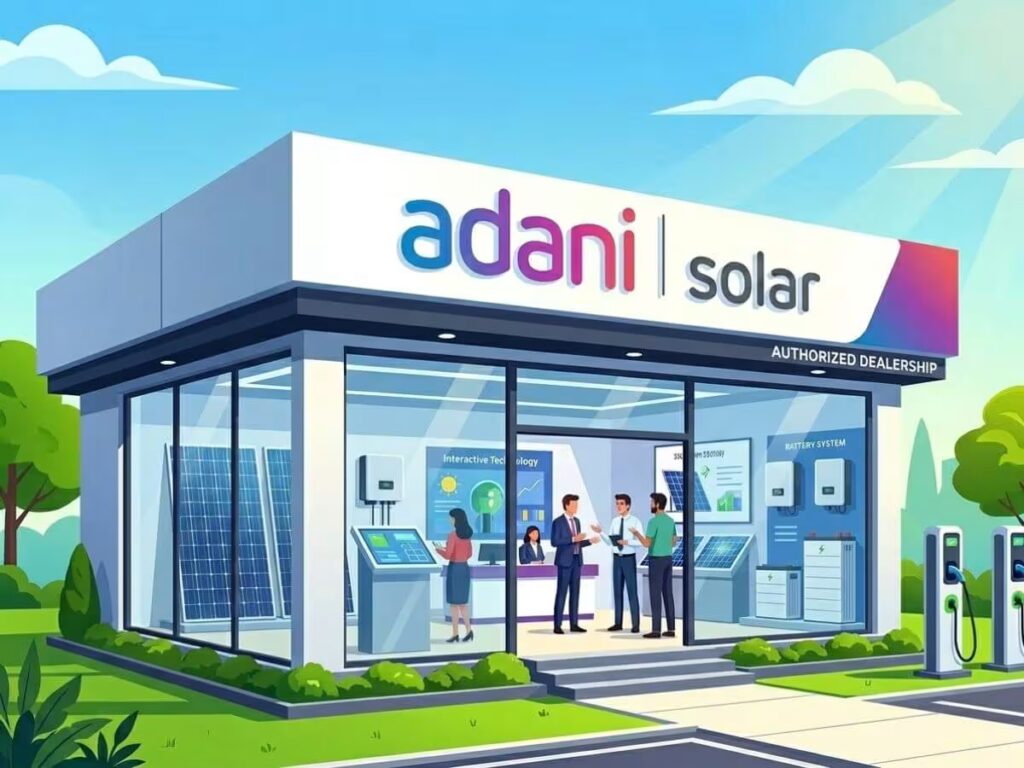
Authorized Dealer
You sell Adani Solar products directly to end customers in your region. This is the most common entry point for first-time entrepreneurs.
Distributor
You supply products to local dealers in your area. This requires higher investment but comes with greater volume and margin potential.
Channel Partner / EPC Installer
You don’t just sell — you also install and provide after-sales service. This model adds more revenue streams but requires technical know-how and manpower.
Choosing the right model really depends on how much capital you have, what your local market looks like, and whether you have any prior experience in the solar or electrical sector.
Adani Solar Dealership Cost
The total investment for an Adani Solar dealership typically ranges between ₹15 lakh and ₹30 lakh for small to medium-scale operations.
For large-scale EPC or utility-grade projects, the investment can go well above ₹1 crore.
Here’s how that money gets split:
Security Deposit / Dealership Fee
This is a one-time fee that varies by region and the scale of your operations. It’s essentially a commitment amount that confirms your authorization as a dealer.
Initial Inventory
This is usually the biggest chunk of your investment. Small dealers typically start with stock worth ₹5–10 lakh, while distributors working with commercial clients may need ₹15–20 lakh or more in initial inventory — panels, inverters, mounting structures, and accessories.
Storage / Showroom Setup
You’ll need a commercial space of at least 200–500 sq. ft. for a small dealership. Medium setups often rent 200–800 sq. ft. of warehouse space. If you’re already running an electrical or hardware shop, you might be able to use existing space, which reduces this cost significantly.
Working Capital
This is money you’ll need month-to-month to keep the business running — restocking, logistics, staff salaries, delivery costs, and customer support. Small dealers typically need ₹1–1.5 lakh per month, while medium distributors may require ₹2–4 lakh monthly.
Promotional & Marketing Material
Adani Solar does provide co-branded materials, but you’ll still need to invest in local marketing — signage, digital ads, and community outreach.
Profit Margin in Adani Solar Dealership
Adani Solar dealers typically work on margins between 10–15% on product sales, with overall project execution margins ranging 20–35% if you’re handling installation as well.
On an average monthly sale of ₹10 lakh, a well-run dealership can generate a gross profit of ₹1–2 lakh per month.
Dealers who get into after-sales services and Annual Maintenance Contracts (AMC) earn recurring income on top of product sales, which is where the real long-term money lies.
Most dealerships break even within 9 to 18 months, depending on how aggressively you build your customer base and how competitive your local market is. Tier 2 cities and rural areas are actually showing faster growth right now, because urban markets are getting crowded.
One more thing worth mentioning: banks like SBI, HDFC, and Union Bank tend to prefer projects that use Adani modules, which means financing is easier for your customers — and that makes closing deals smoother for you.
What Are Adani Solar Panel Prices Right Now?
As a dealer, knowing the current market price of panels helps you estimate both your inventory cost and your selling margin.
The Adani Solar panel prices in India are approximately:
- Polycrystalline panels: ₹25–30 per watt
- Monocrystalline panels: ₹30–35 per watt
- Bifacial (Glass-to-Glass) panels: ₹35–40 per watt
For reference, a popular 520W panel costs around ₹16,120, and a 650W panel is priced at roughly ₹18,850 (prices inclusive of GST and vary by location and order volume).
It’s worth noting that Adani Solar has now upgraded its entire portfolio to Bifacial Glass-to-Glass (G2G) technology, phasing out the older polymer backsheet panels. As a dealer, this is actually a strong selling point — G2G panels are more durable, fire-safe, and carry a 30-year performance warranty.
What Documents and Requirements Do You Need?
Getting an Adani Solar dealership isn’t as complicated as it sounds, but you do need to have your paperwork in order. Here’s what’s generally required:
- A valid business entity (Sole Proprietorship, Partnership Firm, or Private Limited / LLP)
- GST registration
- PAN card and Aadhaar
- Bank account statements (to demonstrate financial capacity)
- Address proof for commercial space
- Property documents for storage or showroom
- Shop and establishment license (where applicable)
Prior experience in the electrical, solar, or construction sectors is a plus but not mandatory. Adani Solar provides technical and operational training to onboarded partners.
How to Apply for an Adani Solar Dealership
To apply for the dealership, the process is fairly straightforward:
- Visit the official Adani Solar website
- Navigate to the “Contact” or “Partner With Us” section
- Fill in your business inquiry form with your profile, investment capacity, target market, and any prior experience
- Wait for initial screening — the company evaluates your financial strength, location viability, and technical capability
- Once approved, you sign the agreement, receive training, and get your supply chain set up
The whole process from application to approval typically takes 2–4 weeks, assuming your documents are ready.
If you’re in a city or town where solar adoption is growing — and frankly, that’s almost everywhere in India right now — an Adani Solar dealership is a genuinely solid business opportunity. The brand recognition does a lot of the selling for you, government subsidies are pushing more households toward solar than ever before, and the product quality means fewer complaints and returns.
The entry cost of ₹15–30 lakh is not small — but for a business with strong recurring demand, a 25-year product lifespan, and government tailwinds, the risk-reward ratio is quite reasonable. For entrepreneurs who are already in the electrical, construction, or real estate business, this is an especially natural add-on.
Start small, build your local network, get a few residential installations done, collect reviews, and scale from there. That’s the playbook that’s working for dealers across the country.

Suraj Shetty
Suraj Shetty has over 8 years of experience in small business, startups, and business consulting. He shares practical insights and proven strategies to help entrepreneurs discover new opportunities and grow their businesses sustainably.

Ravi Shankar
28 years of experience in business consulting across diverse industries