Every second Indian home has a piece of pottery tucked away somewhere — a clay diya saved from last Diwali, a matka cooling water in the kitchen, a terracotta planter on the balcony.
That same craft, once seen as a low-margin village trade, is turning into a genuine small business opportunity, thanks to a growing appetite for handmade and eco-friendly products and some real government money sitting behind it.
I spent the last few weeks going through equipment listings, government scheme documents, and a fair number of artisan YouTube channels to put together a realistic picture of what a pottery business actually costs in India right now.
I’m not giving a vague “a few lakhs” answer you’ll find everywhere, but numbers you can actually plan a budget around.
In this post,
How Much Does It Cost to Start a Pottery Business?
There’s no single number here, and anyone who gives you one is oversimplifying. A home-based, hobby-turned-business setup — one wheel, no kiln of your own, firing done at a shared studio or a local kumhar’s bhatti — can realistically get going for ₹50,000 to ₹1.5 lakh.
Step up to a proper small unit with your own electric wheel and a compact kiln, and you’re looking at roughly ₹3 lakh to ₹8 lakh.
A semi-commercial workshop with multiple wheels, a mid-size kiln, a pug mill for clay processing, and a dedicated shed typically falls in the ₹10 lakh to ₹25 lakh range — which, not coincidentally, is also the bracket most government scheme money is built around.
Large, export-oriented ceramic units with automated lines are an entirely different game and can run into several crores. For most first-time entrepreneurs, the realistic starting point sits somewhere between the first two brackets.
Potter’s Wheel, Kiln, and Other Equipment Costs
The wheel is usually the cheapest part of this business, and the kiln is usually the part that catches people off guard. A basic hand-operated or entry-level electric wheel starts around ₹1,200 to ₹3,500. While a decent electric wheel suited for regular small-business use runs ₹6,000 to ₹25,000 depending on motor strength and wheel-head size.
Heavy-duty studio wheels built for 30-45 kg clay centering can cross ₹50,000-₹90,000, though you won’t need that scale on day one. The kiln is where your budget really gets tested. Compact electric kilns for small batches start around ₹40,000 to ₹1.5 lakh, mid-size business kilns sit in the ₹1.5 lakh to ₹4 lakh range, and larger multi-chamber or industrial kilns can cross ₹5 lakh to ₹10 lakh.
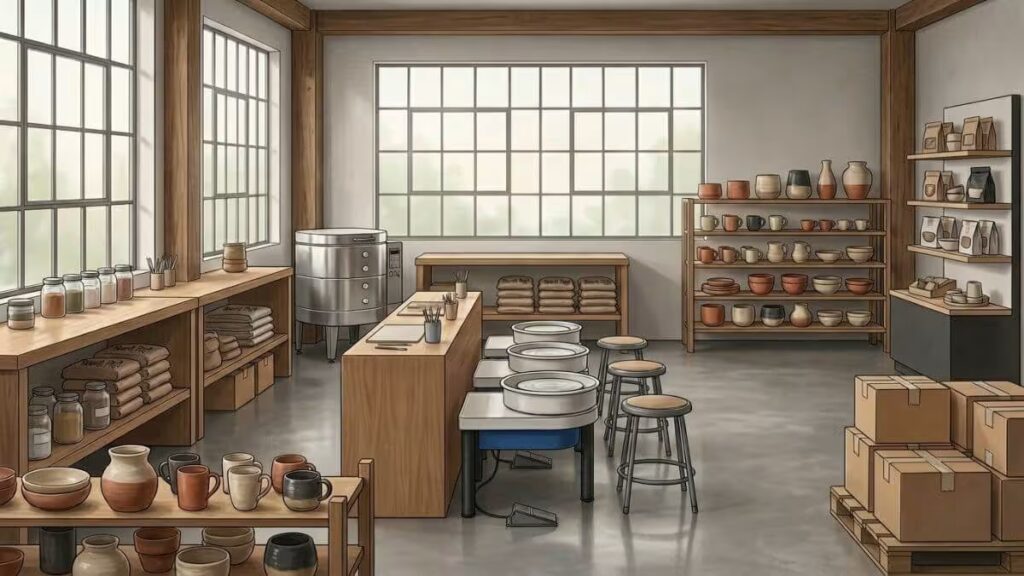
Gas-fired kilns are sometimes cheaper upfront, with entry models from around ₹65,000, though running costs work differently. If you’d rather not buy a kiln on day one, a pug mill or blunger for kneading clay (₹40,000-₹1.5 lakh) is the other big-ticket item, alongside shelves, drying racks, hand tools, and a small glazing area, which together add another ₹10,000-₹30,000.
Clay, Glaze, and Monthly Running Costs
Clay cost swings wildly depending on where you source it. Traditional kumhars who dig and process their own clay locally pay almost nothing beyond transport, which is exactly why pottery has survived as a low-capital trade for generations.
Bought-in industrial clay typically costs ₹15-50 per kg, while refined, ready-to-throw studio clay bodies like stoneware or porcelain can run ₹100-350 per kg or more. Glaze materials usually add another ₹20-40 per piece.
The cost people forget to budget for is electricity — a single firing in a mid-size kiln can easily use ₹500-1,500 worth of power, and a half-empty kiln load wastes that money just as fast as a full one. Add fragile-item packaging, which routinely eats up 8-12% of costs once you start shipping, and your real monthly running cost usually ends up higher than the raw material bill alone suggests.
How Much Profit Can You Make From a Pottery Business?
Wage data for working potters in India typically show monthly earnings of roughly ₹18,000 to ₹42,000 to start, climbing toward ₹80,000 for those with five-plus years of skill behind them.
Independent potter households relying purely on the craft tend to report more modest numbers — regional studies have found average annual family income hovering around ₹1.5 lakh for subsistence-level units, climbing past ₹5 lakh for the better-positioned ones. The real difference-maker is who you’re selling to.
Wholesale supply to shops keeps margins thin, but direct-to-consumer sales — through Instagram, your own website, exhibitions, or marketplaces — routinely push gross margins to 40-60%, since your material cost per piece is small; the real value sits in skill, design, and the firing process. Festive and wedding seasons, especially the run-up to Diwali, tend to be when small pottery businesses make most of their year’s money.
Government Loans and Subsidies for Pottery Businesses
This is the part most first-time potters in India don’t research properly, and it’s where a chunk of your investment can come from somewhere other than your own pocket. The PM Vishwakarma Yojana is the most directly relevant scheme, since it specifically recognises the Kumhaar (potter) as one of its 18 covered trades. Registered artisans get a ₹15,000 toolkit voucher, a ₹500-a-day stipend during skill training, and a collateral-free loan of up to ₹3 lakh released in two tranches — ₹1 lakh first, then ₹2 lakh — at a concessional 5% interest.
For a bigger unit, PMEGP (run through KVIC) covers manufacturing projects up to ₹50 lakh, with a government subsidy of 15-35% of project cost that you never repay, while you contribute only 5-10% yourself and a bank finances the rest at around 11-12% interest. KVIC also runs its own pottery-specific equipment support through state Khadi offices, often providing subsidised electric wheels and work-shed assistance to traditional artisan groups.
The Mudra loan scheme is worth knowing too, now offering collateral-free credit up to ₹20 lakh across its Shishu, Kishor, Tarun, and newer Tarun Plus categories. A smart approach many artisans follow is starting with PM Vishwakarma for the cheap entry loan and toolkit, building a repayment record, and graduating to PMEGP once ready to scale into a full unit.
Registration Costs
The good news is that formal registration barely adds to your cost. Udyam Registration, India’s MSME registration, is completely free, done online through self-declaration, and takes minutes — you’ll need it anyway to access the schemes above.
GST registration isn’t mandatory until turnover crosses ₹40 lakh for goods in most states (₹20 lakh in a few special-category states), so many home-based potters can skip it initially, though selling on major e-commerce marketplaces or across state lines usually requires a GSTIN regardless of turnover.
A local trade licence from your municipal corporation typically costs a few hundred to a couple of thousand rupees, and if you’re running a kiln, it’s worth checking local pollution-control norms before firing commercially.
Ways to Reduce Your Pottery Business Startup Cost
If ₹3-8 lakh sounds steep to begin with, you don’t have to spend it all upfront. Start home-based with just a wheel, and use a shared community kiln or pay a local pottery cluster a per-firing fee instead of buying your own kiln on day one. Secondhand wheels and kilns from studios that are shutting down or upgrading show up fairly often on local resale marketplaces at a fraction of new prices.
Apply for PM Vishwakarma first, since it’s nearly free to enter and gives you a toolkit and training before you commit serious money, then move to PMEGP once you have a track record. Source clay locally rather than buying processed studio clay bodies wherever your region allows it, and sell directly online before paying for retail shelf space.
Compared to most manufacturing businesses, pottery remains one of the lower-capital routes to becoming your own boss in India, and between PM Vishwakarma, PMEGP, and Mudra, there’s more government money chasing this craft right now than at almost any point before.
What decides success isn’t the capital, though — it’s whether you can turn raw clay into something people actually want to buy, and whether you can get it in front of them. Get those two things right, and the cost of starting turns out to be the easy part.

Suraj Shetty
Suraj Shetty has over 8 years of experience in small business, startups, and business consulting. He shares practical insights and proven strategies to help entrepreneurs discover new opportunities and grow their businesses sustainably.

Ravi Shankar
28 years of experience in business consulting across diverse industries