
If you ask any carpenter in your town which plywood brand he trusts, CenturyPly will come up within the first two or three names.
So it is no surprise that many shop owners and first-time business people want to know what it takes to become a dealer, and more importantly, how much money they need to arrange.
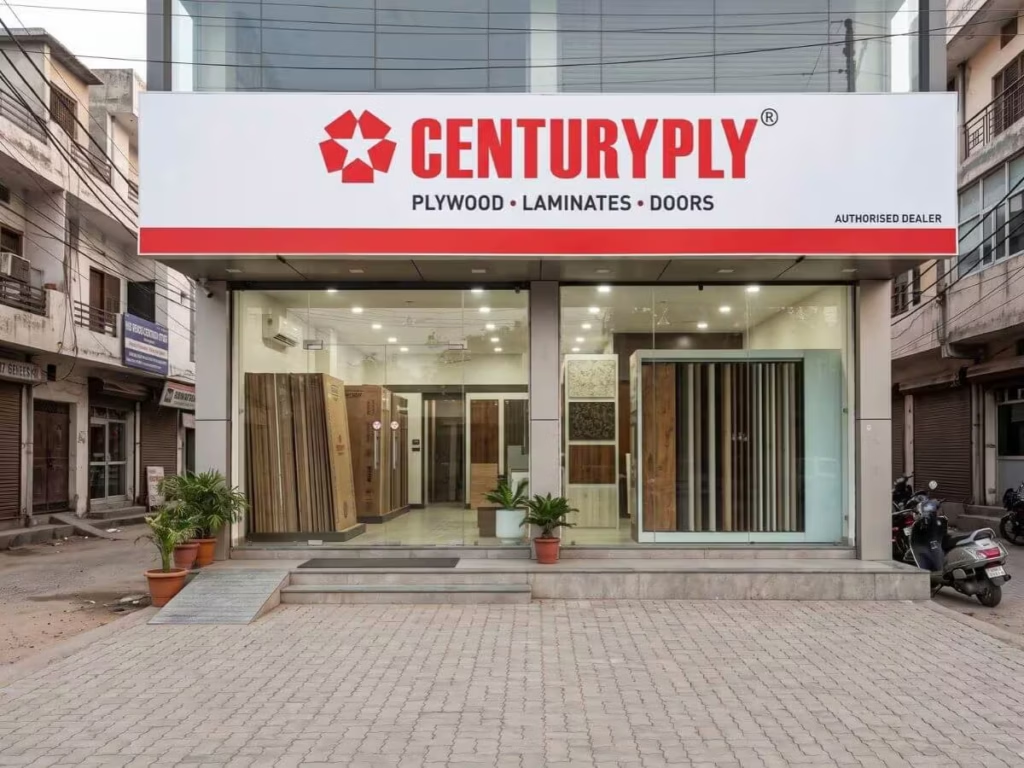
CenturyPly holds the largest estimated market share of around 30% in India’s organised plywood sector, and it is present pan-India with a distribution network of nearly 3,924 trade partners, spread across 28 states and 7 union territories.
So if you’re thinking of becoming a part of this network, you’re plugging into a well-oiled supply and demand machine.
But before you decide, first let’s talk about the thing that matters most. How much does it cost to start a CenturyPly dealership in India?
In this post,
What Is a CenturyPly Dealership?
A CenturyPly dealership (or authorized dealer) means you are an official point of sale for CenturyPly’s product range. The CenturyPly product range includes plywood, block boards, doors, laminates, and veneers.
In more recent years, the company has expanded into WPC boards, PVC boards, composite panels, and even exterior-grade products. So as a dealer, you won’t just be selling sheets of plywood — you’ll be selling a comprehensive portfolio of interior and building products.
CenturyPly’s official dealer page allows you to join their network of authorized dealers and offer premium products with unmatched quality through strong, trusted partnerships.
The company also has a specific programme for its popular sub-brand. Interested entrepreneurs can apply for a CenturyPly Sainik 710 plywood dealership — which is a smart entry point because Sainik is one of the most in-demand, value-for-money plywood products in India right now.
How Much Does a CenturyPly Dealership Cost?
This is the question everyone Googles, and nobody gives a straight answer to. So let’s break it down.
The investment you need depends on multiple factors — your city, the scale of your operations, your shop/godown size, and the initial stock you want to maintain. Here’s a realistic breakdown:
Shop and Storage Space
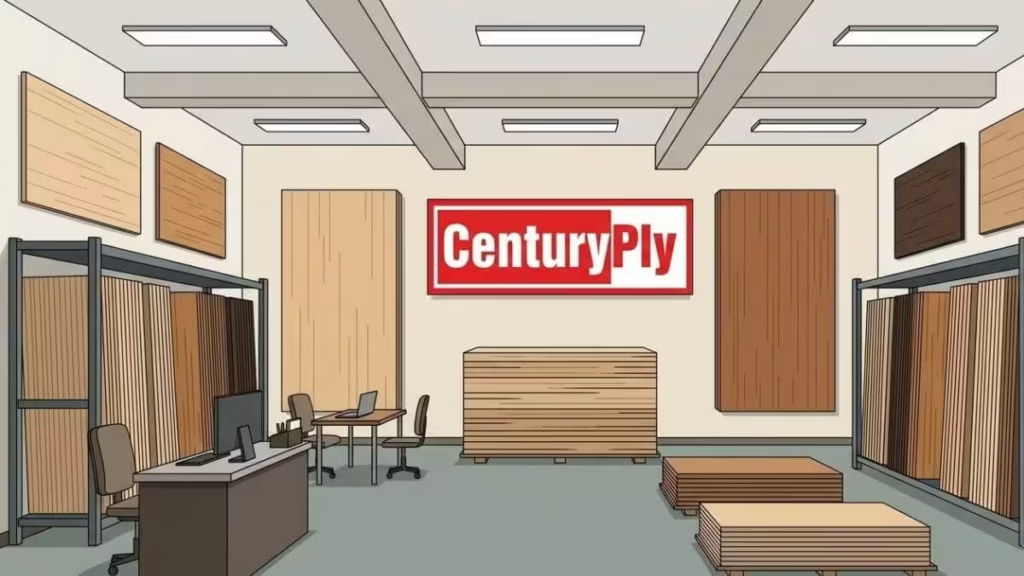
You’ll need a retail-facing shop and a godown or warehouse to store plywood sheets, boards, and doors. Plywood comes in large 8×4 feet sheets, so you need at least 500-1000 sq. ft. of space, ideally more. In Tier 2 and Tier 3 cities, renting this space could cost anywhere from ₹15,000 to ₹40,000 per month. In metros, expect significantly more.
Initial Inventory (Working Capital)
This is the biggest chunk of your investment. In India’s plywood trade, each intermediary in the chain adds 5-20% based on negotiation power and market tightness. To stock a meaningful range of products — different grades, sizes, and thicknesses — you’ll typically need an initial inventory investment of ₹5 lakh to ₹15 lakh, depending on the scale you want to start with.
Security Deposit and Shop Setup
Interior fit-outs, signage, display racks, and a security deposit for your commercial space can add another ₹1 lakh to ₹3 lakh to your startup cost.
Miscellaneous Costs
This includes GST registration, business registration, a vehicle or transport arrangement for delivery, and basic staff costs. Budget ₹50,000 to ₹1 lakh here.
Putting it all together, a realistic total investment to start a CenturyPly dealership in a Tier 2 or Tier 3 town in India comes to approximately ₹8 lakh to ₹20 lakh. In metros like Mumbai, Delhi, or Bengaluru, the number can climb considerably higher due to real estate costs alone.
What Are the Products You’ll Be Selling?
You must know the kinds of products CenturyPly offers. Understanding the price range helps you figure out your working capital needs and sales potential. Here’s a quick look at popular CenturyPly products and their approximate price ranges.
CenturyPly Architect Ply is priced at ₹266–399 per sq. ft., Club Prime at ₹128–150 per sq. ft., Classic Marine at ₹140 per sq. ft., and Sainik 710 at ₹109–114 per sq. ft.
The entry-level BWP options start around ₹90-110 per sq. ft. for standard 18- 19 mm thicknesses, scaling to ₹140-170 for premium variants with added tech like antimicrobial coatings.
The Sainik 710 range is especially important for dealers in semi-urban areas. Starting at just ₹114 per unit including GST (929 sq. cm) for 19mm plywood and blockboard, Sainik 710 is a marine-grade plywood that is boiling waterproof. It’s popular because it offers quality without burning a hole in the customer’s pocket — which means it moves fast off the shelf.
How Profitable Is a CenturyPly Dealership?
Dealers in India’s plywood market are averaging 8-12% net profitability, with top performers — those with diversified product portfolios — hitting 15% via 20-30% turnover growth.
The mid-range dealer price segment offers attractive margins for distributors while keeping products competitively priced for end consumers.
What this means is, if your monthly turnover is ₹5 lakh, you could be netting ₹40,000 to ₹60,000 per month. Scale that to ₹15-20 lakh monthly turnover — which is very achievable in a growing city with good contractor contacts — and your net income starts to look very comfortable.
Dealers who also sell laminates, doors, and WPC boards alongside plywood tend to do even better because they are catering to the full requirement of a home builder or interior designer in one shot.
How to Apply for a CenturyPly Dealership
The application process is fairly easy. CenturyPly’s official website has a “New Dealer Request” form where you can become a partner by selecting your state and city. Once you submit the form, a company representative from your region reaches out to discuss your application and assess your location, storage capacity, and business plan.
You’ll need to have the following in order:
- A valid GST registration
- A shop/godown with adequate space
- Working capital commitment
- Basic documents like PAN, Aadhaar, business registration proof, and address proof
There’s no formal “franchise fee” involved — CenturyPly operates on a dealer/trade partner model, not a franchise model. You buy their products at dealer pricing and sell them in your market. The margin is your income.
You can also reach them through their toll-free customer care number: 1800-5722-122, or through their official WhatsApp.
Also Read:
How to start a Greenply dealership – Complete guide
You Should Know This Before You Decide
A few honest points to consider before you invest:
Location matters more than anything.
A CenturyPly dealership in a city with active construction, interior design firms, and furniture manufacturers will always outperform one in a low-activity market. Check the construction pace in your area before committing.
Competition exists.
India’s plywood market is witnessing a significant transition from unorganised to organised sector as consumers increasingly prioritise quality assurance, brand reliability, and warranty-backed products. This shift is good for branded dealers like yourself. But you’ll still compete with local plywood shops and other brands.
Also Read:
How to start a Plywood Business – Complete guide
The full product range is an advantage.
CenturyPly operates state-of-the-art manufacturing facilities across India, including locations in Chennai, Kandla, Karnal, Guwahati, Joka, Badvel, Roorkee, and Hoshiarpur. This means supply is generally stable. And because CenturyPly is a leading plywood brand in India due to its wide product range, advanced manufacturing, 25+ rigorous quality tests, industry-recognised certifications, and strong distribution network, customers trust the brand — which makes your job as a dealer considerably easier.
Like any trade business, a CenturyPly dealership takes 12 to 18 months to properly stabilise. The first few months are about building relationships with contractors, carpenters, builders, and interior designers in your area. Once those relationships are in place, repeat business becomes your biggest asset.
Starting a CenturyPly dealership is one of the more stable and sensible small business ideas in India’s building materials space. The brand does the heavy lifting in terms of awareness, quality assurance, and product development. Your job is to connect supply with local demand — and build the trust network that keeps contractors and homeowners coming back to your shop.
With an investment starting from roughly ₹8 lakh on the lower end and a realistic profit margin of 8-15%, it’s a business that rewards people who show up consistently and know their local market well. Whether you’re in a busy Tier 1 city or a fast-growing Tier 3 town, the demand for quality plywood isn’t going anywhere — and neither is CenturyPly.

Suraj Shetty
Suraj Shetty has over 8 years of experience in small business, startups, and business consulting. He shares practical insights and proven strategies to help entrepreneurs discover new opportunities and grow their businesses sustainably.
Kaushik Nitin
30 years of experience in business consulting across diverse industries