
Last Updated on October 18, 2026 by Suraj Shetty and Anoop Dewan
We all know that there is a huge demand for building materials in India. One such material is ceramics/tiles. You can start a ceramic or tile business by selling multi-brand products, or you can partner with any brand and open an exclusive showroom for that brand.
There are many well-established tile / ceramic brands in the country, such as Kajaria, Orient Bell, Somany, Nitco, etc. You can partner with these brands and start a tile dealership business.
Out of these brands, in this article, we will give you complete information about the Somany tiles dealership.

This article contains all the topics related to the Somany dealership, which includes Somany tiles dealership cost, profit margin, shop space required, licenses, and registrations, whom to contact, etc.
In this post,
Why choose Somany dealership?
Somany Ceramics is India’s second-largest tiles manufacturer with a presence of over 500 exclusive retail outlets and more than 15,000 dealers and sub-dealers across the country.
As a Somany dealer, you sell their range of ceramic wall and floor tiles, polished vitrified tiles, glazed vitrified tiles, large-format slabs (marketed as Somany Max), sanitaryware and bath fittings.
The dealership operates under a franchise-style arrangement. Somany appoints you as an authorised dealer for a defined territory. You run the showroom, handle stock, serve walk-in customers and build relationships with local contractors, architects and builders.
The company provides display material, brand support and access to their product range. The investment and the operational risk are yours.
Somany has three main showroom formats — Studio (around 1,000 sq ft), Grande (2,500–5,000 sq ft) and the newer Somany Max format for large-format slabs. Which format you get depends on your location, territory potential, and the investment you bring in.
Somany Tiles Dealership Cost
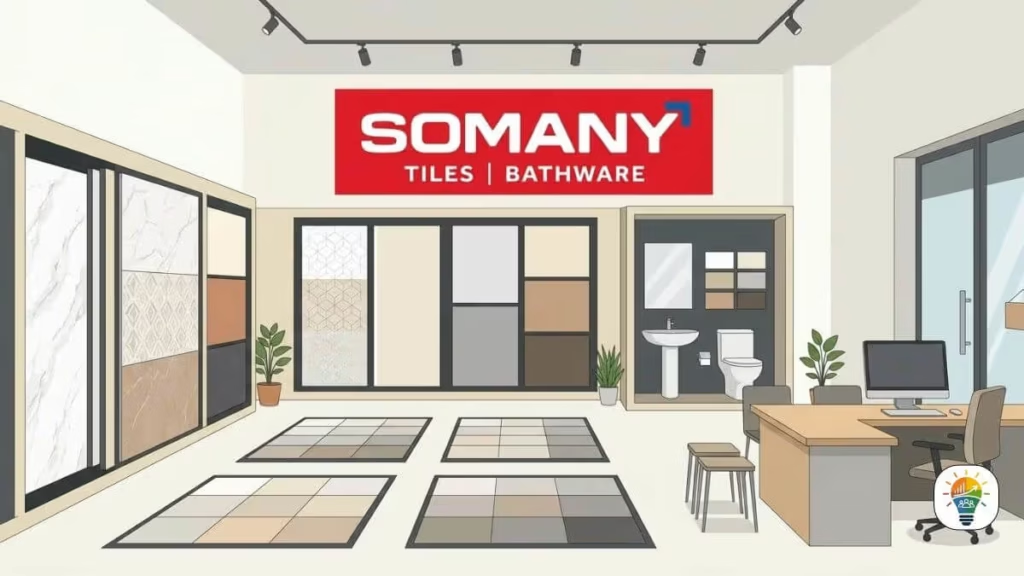
The cost to start a Somany dealership depends upon the location and the type of showroom format you choose.
Low-end setup (Tier 3 town, smaller Studio format): ₹15–20 lakh
Mid-range setup (Tier 2 city, Grande format): ₹30–50 lakh
Large format setup (Tier 1 city or large territory, Somany Max): ₹60–90 lakh or more
These are total startup figures including all costs below. A Somany dealership is not a ₹5 lakh counter-shop opportunity. It needs meaningful capital.
Cost Breakdown for a Somany Tiles Dealership
Here is where the money goes.
| Cost Head | Approximate Range |
|---|---|
| Showroom interior and display setup | ₹5–20 lakh |
| Initial inventory (tiles and sanitaryware) | ₹8–25 lakh |
| Showroom rent deposit (3–6 months) | ₹1–6 lakh |
| Security deposit to Somany | ₹1–3 lakh |
| Signage, branding and visual merchandising | ₹1–3 lakh |
| GST registration, Shops Act, MSME and other licences | ₹10,000–30,000 |
| Billing software and IT setup | ₹30,000–60,000 |
| Working capital (3 months running expenses) | ₹3–8 lakh |
Showroom interiors are where the large investment. Tiles need to be displayed on full vertical panels, not just stacked in boxes. A proper display wall with lighting can run ₹3,000–5,000 per panel, and a 2,500 sq ft showroom may need 40–60 panels. That alone is ₹1.5–3 lakh before you stock a single tile.
Monthly Running Costs
Once you are open, these are the recurring expenses every month.
Rent for a commercial space in a Tier 2 city runs around ₹30,000–80,000 for a 2,000–3,000 sq ft showroom. In metros or prime areas, this can easily cross ₹1.5 lakh.
Salaries for 2–3 staff (a salesperson, a store helper, and an accountant or billing person) will be ₹40,000–80,000 combined, depending on your city and experience level.
Freight and logistics is a cost tiles dealers often underestimate. Tiles are heavy and fragile. Inward freight from the Somany warehouse to your store plus delivery to customer sites can run ₹20,000–40,000 per month depending on volume.
Add utilities, packaging material, petty maintenance, and miscellaneous to get a total monthly overhead of roughly ₹1.2–2.5 lakh for a mid-size Somany dealership.
What Is the Profit Margin in Somany Tiles Dealership?
Branded tiles like Somany carry a dealer margin of roughly 8–15% on the MRP, depending on the product category and your monthly purchase volume. Premium vitrified and GVT tiles tend to have slightly better margins than basic ceramic tiles. Bathware and sanitaryware margins can be a bit higher — sometimes touching 18–20%.
Volume targets matter. Somany, like most tile brands, structures tiered incentives. Dealers who hit higher purchase volumes get additional rebates or scheme benefits of 1–3% on top of the base margin. So a dealer doing ₹15 lakh per month in purchases is not in the same position as one doing ₹5 lakh.
Net profit margin after all operating expenses — rent, salaries, freight, breakage — typically settles at 6–10% of revenue for a well-run Somany dealership. On a monthly turnover of ₹8–12 lakh (achievable in a Tier 2 town within the first 12–18 months), that translates to a net monthly profit of ₹50,000–1,00,000.
How Long Does It Take to Break Even?
For a mid-size setup with a total investment of around ₹35–40 lakh, the break-even typically comes in 24–36 months. This assumes steady growth in monthly sales, no major dead stock problem, and a location with decent construction activity nearby.
A well-placed dealership in a town with active residential or commercial construction can break even faster — sometimes in 18 months. A poorly located showroom or one with heavy competition from nearby unorganised dealers can take much longer.
Hidden and Overlooked Costs in the Tiles Business
Tiles arrive in cases, get moved to displays, get shifted for customer viewing, and are delivered to sites. Industry insiders estimate breakage and damage losses of 2–4% of inventory value annually. This never appears in the business plan most people make.
Dead stock is an even bigger trap. Tiles go out of fashion faster than you expect. A design that was popular two years ago may not move today. Slow-moving stock blocks your working capital and eats margin when you eventually have to discount it.
Credit to contractors is standard practice. Most tile dealers give 30–45 days’ credit to builders and contractors, who often stretch it to 60–90 days. If your turnover is ₹10 lakh per month and your average credit period is 60 days, you have ₹20 lakh locked in receivables at any given time. Plan for this from day one.
GST on tiles is at 18% for most vitrified and ceramic categories. This is a pass-through cost, but it increases the invoice value your buyers see, and managing monthly GSTR filings properly requires either a capable accountant or reliable software.
Licenses and Registrations Required
These are the licenses and registrations required to open a Somany tiles dealership in India.
- Company Registration – Sole proprietorship/LLP/Pvt Ltd
- Trade Licence – from your local municipality
- Shop & Establishment Registration – from the state government
- GST Registration
- Previous bank statement / Income Tax Returns
- Business Insurance if required
If you lack capital, you can contact banks like SIDBI for business loans.
Related:
How to Start a Somany Dealership?
To get a Somany tiles dealership, first, you need to contact your area’s Somany sales manager. You can get his number by calling Somany’s toll-free number 1800-1030-004

You can also contact them at their official website.
Once you contact the brand, they will be in touch with you and if you are eligible, then help you in launching your dealership.
They look at a few things: your space (they have minimum area requirements per format), your financial capacity, whether there is already a Somany dealer nearby and the market potential of your territory. Once approved, you execute a dealership agreement, pay the security deposit and place your first inventory order.
The process can take 4–10 weeks from first enquiry to approval.
You may also Like:
- Orient Bell Dealership | Complete Guide
- Qutone Tiles Dealership Cost | Complete Guide
- H&R Johnson Tiles Dealership | Complete Details
Can You Start Smaller?
If the investment above feels heavy, there is a middle path. Starting as a sub-dealer under an existing Somany authorised dealer is one route — lower investment, lower risk, and you still get access to Somany products. You earn a smaller margin (typically 4–6%), but it lets you test the market before committing to a full dealership.
Another option is starting with a smaller 1,000 sq ft Studio format, if Somany approves it for your territory. The setup cost drops to ₹15–20 lakh, and you can add bathware or sanitaryware later once cash flow stabilises.
MUDRA loans under the Tarun category (up to ₹10 lakh) can cover part of your working capital requirement. However, a dealership of this scale would more typically look at a term loan from a bank against property collateral rather than a micro-finance product.
The tiles market in India is large and growing, supported by steady demand from residential construction. Somany is a trusted brand with good recognition among architects, contractors, and homeowners. Having their name on your signage brings credibility from day one.
That said, the margins in branded tiles are not spectacular. The money is made on volume, consistency, and building strong relationships with local contractors and builders who bring repeat business. Location is critical — a showroom tucked away from a construction-heavy area will struggle regardless of how good the brand is.
Expect the first year to be slow. Month-on-month sales build as word spreads and you get on the contractors’ shortlist. Most successful tile dealers in India will tell you the business rewards patience more than hustle.
SmallBusinessHub.in is an independent informational website and is not affiliated with the brands or companies mentioned unless explicitly stated. Business, franchise, dealership, and investment information is provided for general informational purposes only and may change over time. Always verify details directly with the relevant company before making a business decision. We do not provide financial, legal, or investment advice. [Read our full Disclaimer].

Suraj Shetty
Suraj Shetty has over 8 years of experience in small business, startups, and business consulting. He shares practical insights and proven strategies to help entrepreneurs discover new opportunities and grow their businesses sustainably.

Anoop Dewan
20 years of experience in Entrepreneurship


Comments are closed.