
Last Updated on October 21, 2026 by Suraj Shetty and Ravi Shankar
A Simpolo Tiles dealership in India requires a total investment of roughly ₹20 lakh to ₹45 lakh, depending on city, showroom size, and opening stock. The core costs cover showroom setup, display material, inventory, and working capital. Dealers earn a gross profit margin of around 10% to 18% on tile sales, with the exact figure depending on sales volumes and product mix. A well-run dealership in a growing town can expect to break even within 18 to 30 months.
In this guide,

Every time a new apartment complex goes up on the outskirts of a Tier-2 city, someone is buying floor tiles, bathroom tiles, and wall tiles. Multiply that across thousands of construction projects happening simultaneously across India, and you start to see why the tiles dealership business rarely goes quiet.
There are many well-established tile / ceramic brands in the country such as Kajaria, Orient Bell, Somany, Simpolo, H&R Johnson, Nitco, etc. You can partner with these brands and start a tile dealership business.
Out of these brands, in this article, we will give you complete information about the Simpolo tiles dealership.
Simpolo Ceramics, a Morbi-based manufacturer established in 1977, has built a pan-India dealer network on the back of this steady demand. If you are considering a Simpolo tiles dealership, the questions you most need answered are about money — what goes in, what comes back, and when.
This article answers all of that.
About Simpolo Tiles Dealership?
Simpolo Ceramics is headquartered in Morbi, Gujarat — the city that produces around 90% of India’s tiles. The company has been manufacturing ceramic and vitrified tiles since 1977 and today sells wall tiles, floor tiles, vitrified tiles (GVT and PGVT), full-body tiles, outdoor tiles, and sanitaryware.
The brand operates over 200 exclusive showrooms across India and Nepal and has authorised dealers in almost every state. For a dealer, the brand’s recognition matters because it reduces the effort needed to convince customers. Builders, contractors and homeowners who already know Simpolo are easier to convert than customers who have never heard of the brand.
Simpolo sits in the mid-premium segment. Its tiles retail roughly between ₹23 and ₹90 per square foot for standard lines, with premium and large-format collections going higher. That price point attracts the upper-middle segment — the sweet spot in most Indian cities right now.
Simpolo Tiles Dealership Cost
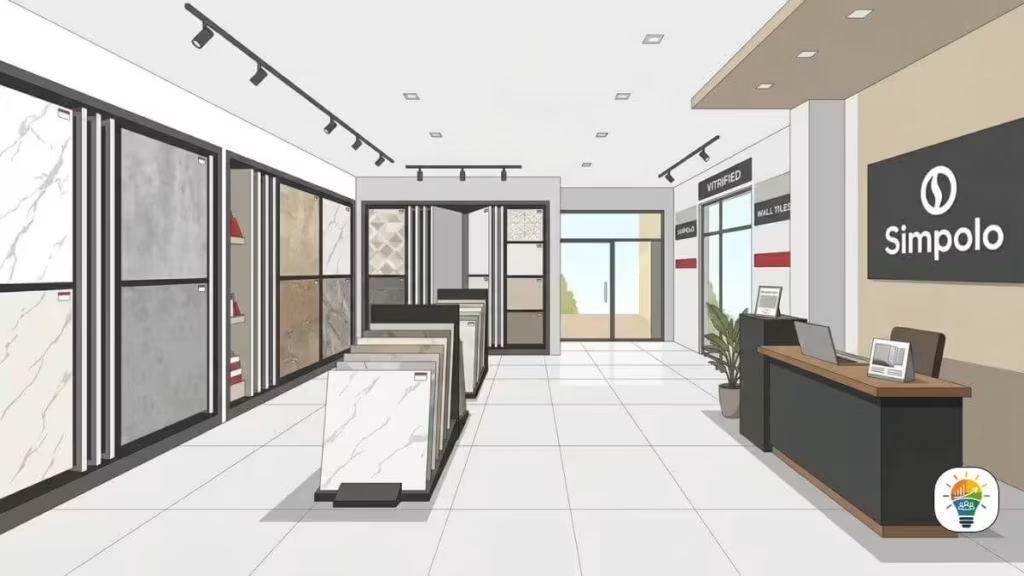
The total investment to start a Simpolo tiles dealership falls in a realistic range of ₹20 lakh to ₹45 lakh for a brand-exclusive setup. The lower end applies to a smaller showroom in a Tier-2 or Tier-3 town where rent is modest, and you own or have cheap access to warehouse space. The higher end applies to a larger showroom in a metro or Tier-1 city, or when you are renting both your showroom and your godown.
Here is a practical cost breakdown.
| Cost Head | Low Range | High Range |
|---|---|---|
| Showroom setup and interiors | ₹2,00,000 | ₹5,00,000 |
| Display racks, tile panels, lighting | ₹1,50,000 | ₹3,00,000 |
| Opening inventory (stock) | ₹8,00,000 | ₹18,00,000 |
| Rent deposit (showroom + godown) | ₹1,50,000 | ₹5,00,000 |
| GST + trade licence + registrations | ₹15,000 | ₹30,000 |
| Working capital buffer | ₹3,00,000 | ₹6,00,000 |
| Miscellaneous (signage, uniforms, POS) | ₹50,000 | ₹1,50,000 |
| Total Estimated Investment | ₹16,65,000 | ₹38,80,000 |
Round figures to ₹20 lakh on the low side and ₹40 to 45 lakh on the high side once you add early-month operating costs.
The inventory component is the single biggest variable. You can start leaner by adopting a display-led model — holding samples and ordering against confirmed customer orders — rather than keeping full godown stock. This cuts your opening outlay significantly but also slows down your ability to close same-day orders.
Monthly Running Costs to Plan For
Once you are operational, your fixed and variable monthly costs will look roughly like this for a mid-sized showroom in a Tier-2 city.
| Monthly Expense | Estimated Amount |
|---|---|
| Showroom rent | ₹25,000 – ₹70,000 |
| Warehouse rent (if separate) | ₹10,000 – ₹25,000 |
| Staff salaries (2 to 3 people) | ₹30,000 – ₹55,000 |
| Electricity | ₹8,000 – ₹15,000 |
| Delivery and transport | ₹5,000 – ₹12,000 |
| Miscellaneous (marketing, stationery) | ₹5,000 – ₹10,000 |
| Total Monthly Overhead | ₹83,000 – ₹1,87,000 |
In a metro, rent alone can push this number significantly higher. In a smaller town where you own your premises, your overheads drop sharply — which is exactly why tile dealerships in fast-growing Tier-2 towns often have better margins than those in cities.
Profit Margin in Simpolo Tiles Dealership
Profit in a tiles dealership comes in layers. Your gross margin — the difference between what you pay Simpolo and what you charge the customer — sits at roughly 10% to 18% depending on the product category and your sales volumes.
Ceramic tiles tend to yield lower margins, around 8% to 12%. Vitrified tiles, GVT and PGVT tiles earn 12% to 18%. Premium or designer tiles and sanitaryware can go to 20% or beyond. Higher-volume dealers who meet company targets also receive scheme bonuses and cash discounts that improve the effective margin on their purchases.
On ₹5 lakh in monthly sales, a 12% gross margin gives you ₹60,000 in gross profit. After monthly overheads of, say, ₹1 lakh, you are at a net loss early on. Once sales scale to ₹8 to 10 lakh per month, the numbers start working meaningfully. A well-established dealership in a growing town typically turns over ₹8 to 20 lakh per month depending on scale and location, with net margins settling around 6% to 10% after all expenses.
The break-even point for most dealerships lands somewhere between 18 and 30 months. The faster you build relationships with local contractors, builders and interior designers, the faster that timeline shrinks.
Hidden Costs That New Dealers Miss
A few costs catch first-time dealers off guard.
Breakage.
Tiles break in transit and in the godown. Budget around 1% to 2% of your stock value for breakage, and make sure you clarify in writing with Simpolo what the returns and claims policy is for transit damage.
Odd lots and slow-moving stock.
Tiles are manufactured in production batches (called lot numbers). Two batches of the same design can differ visibly in shade. If you receive a second batch for a customer’s order and the shade does not match, you have a dispute and unsellable stock. Always keep track of lot numbers and advise customers to order their full requirement in one go, with some extra for cuts and future repairs.
Credit to contractors.
Contractors and builders often expect 30 to 60-day credit. This traps working capital. Manage credit limits carefully, especially early on.
Display maintenance.
Your showroom panels fade and chip over time. Plan a small budget annually to refresh the display — a dull showroom is a slow showroom.
Delivery costs.
You are responsible for getting tiles to the customer’s site. If you do not own a tempo or delivery vehicle, tie up with a trusted transporter and account for per-trip costs upfront.
Space Requirement for a Simpolo Tiles Dealership
The showroom needs a minimum of 800 to 1,000 square feet of display area. Tiles sell best when customers can see them laid out at scale — a 2×4 ft sample board tells them far less than a full floor panel. A well-lit display that mimics a real room makes a meaningful difference to your conversion rate.
Beyond the showroom, you need a separate warehouse of 1,000 to 1,200 square feet. Tiles are heavy (a standard box weighs 18 to 22 kg), and your godown needs a strong floor, dry conditions and space for proper stacking. Never underestimate the handling cost and breakage that come from cramped, poorly organised storage.
In terms of location, footfall is less important than proximity to your buyers. Dealerships placed in hardware and building-material clusters, on arterial roads near construction activity, or close to contractors and architect offices tend to do better than showrooms in purely residential or commercial retail zones.
How to Apply for a Simpolo Tiles Dealership

Simpolo accepts dealership enquiries through its official website at simpolo.com. The company reviews your location, assesses whether an existing dealer already covers that area, and then contacts you for further discussion. You will need to share basic business and financial documents, confirm the proposed showroom space, and agree to the company’s display and stocking norms. Toll-free number: 1800-233-2223
The process is similar to most organised tile brands — there is no fixed franchise fee as such, but you are expected to make the showroom investment and maintain a minimum stock commitment.
Licences and Registrations Needed
The paperwork for a Simpolo dealership is straightforward. You will need:
- Shop and Establishment registration under your state’s Act
- Trade licence from your local municipal body
- GST registration (mandatory, since your business buyers need tax invoices)
- Company registration — sole proprietorship, LLP or Private Limited
- Udyam (MSME) registration, which is free and useful for loan access
If you need financing, MUDRA loans under the Tarun category (up to ₹10 lakh) or business loans from banks such as SIDBI can help fund working capital. State government schemes for small traders and MSME-focused lending are also worth checking with your bank.
The tiles business in India is structurally well-placed. India is the second-largest tile manufacturer in the world, and domestic demand — driven by housing construction, renovation activity, and commercial projects — remains strong.
Simpolo’s mid-premium positioning means you are not chasing the lowest-price buyer, which helps margins. The brand’s existing awareness reduces the time it takes to build customer trust.
That said, there is competition from other mid-premium brands such as Kajaria, Somany, Asian Granito and Orientbell. You will need active relationships with local builders, contractors and interior designers rather than waiting for walk-in customers. Stock management and keeping on top of lot numbers, slow-moving designs, and delivery logistics matter more than most new dealers expect.
For someone who understands their local construction market, has or can lease good showroom space, and is willing to put in the effort on builder and contractor relationships, a Simpolo dealership is a viable, long-term business.
Can I add sanitaryware to my Simpolo tile dealership?
Yes. Simpolo also manufactures sanitaryware, and most tile dealers add it to their showroom since buyers for tiles are often the same people buying bathroom fittings. Sanitaryware typically carries higher margins of 20% to 30%, making it a useful addition to improve the overall profitability of your dealership.
SmallBusinessHub.in is an independent informational website and is not affiliated with the brands or companies mentioned unless explicitly stated. Business, franchise, dealership, and investment information is provided for general informational purposes only and may change over time. Always verify details directly with the relevant company before making a business decision. We do not provide financial, legal, or investment advice. [Read our full Disclaimer].

Suraj Shetty
Suraj Shetty has over 8 years of experience in small business, startups, and business consulting. He shares practical insights and proven strategies to help entrepreneurs discover new opportunities and grow their businesses sustainably.

Ravi Shankar
28 years of experience in business consulting across diverse industries

Comments are closed.